
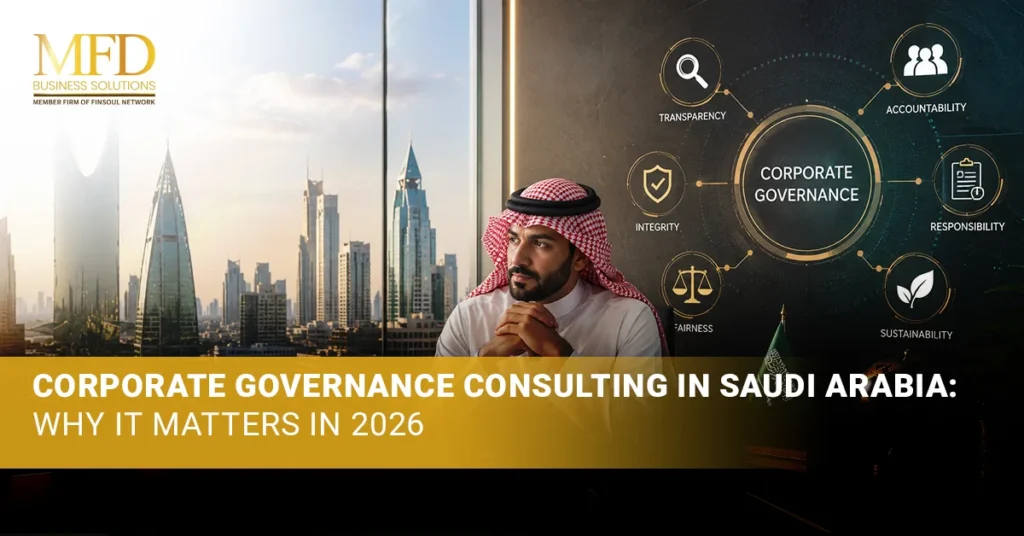
Boardrooms across the Kingdom are under more scrutiny than ever before. Between CMA reporting requirements, growing investor expectations, and the push toward IPO-readiness for family-owned groups, corporate governance consulting Saudi Arabia has moved from a compliance checkbox to a genuine competitive advantage. MFD Services has spent the last several years inside these conversations, helping boards and executive teams close the gap between how they operate today and what regulators, investors, and shareholders now expect. This article looks at what’s changed heading into 2026, why the shift matters, and what a serious governance upgrade actually looks like in practice.
What Changed on the Way to 2026?
For years, governance in many Saudi organizations was treated as a paperwork exercise: a board charter here, a compliance certificate there. That’s no longer sufficient. Regulators have tightened disclosure expectations, family businesses are preparing succession plans with external capital in mind, and institutional investors increasingly screen for governance maturity before committing funds. A weak governance framework Saudi Arabia companies once tolerated is now a red flag during due diligence, and it can quietly kill a deal before negotiations even begin.
Is Corporate Governance Just About Compliance?
No, and this is the misconception that costs businesses the most. Compliance is the floor, not the ceiling. Strong corporate governance consulting Saudi Arabia engagements go further, addressing how decisions actually get made at board level, how conflicts of interest are managed, and how leadership is held accountable for long-term performance rather than short-term wins. A business can technically satisfy every regulatory checkbox and still have a board that rubber-stamps management decisions without real oversight; that’s a governance failure regardless of what the compliance file says.
The Core Pillars of a Strong Governance Structure
Most effective governance upgrades rest on four connected pillars. The table below breaks down what each pillar covers and the common gaps consultants typically find during an initial assessment.
| Governance Pillar | What It Covers | Common Gap Found |
| Board Structure | Composition, independence, committee design | Insufficient independent directors |
| Policies & Compliance | Documented procedures, regulatory alignment | Outdated or generic policy templates |
| Risk Oversight | Risk appetite, internal controls, audit function | No formal risk reporting to the board |
| Transparency & Reporting | Disclosure practices, shareholder communication | Inconsistent or delayed reporting cycles |
Building genuine strength across all four areas is what separates a company that merely survives an audit from one that attracts serious investment.
Why Board Governance Deserves Board-Level Attention
Board governance consulting isn’t only for listed companies. Privately held groups preparing for expansion, succession, or a future IPO benefit just as much, sometimes more, since family-run boards often blend ownership and management in ways that create hidden conflicts of interest. An independent review typically evaluates board composition, decision-making protocols, and whether committees (audit, risk, remuneration) exist and function as intended rather than existing only on paper.
In practice, board governance consulting starts with a candid conversation about who actually holds decision-making power versus who holds it on paper. Many Saudi boards include directors who were appointed for relationship or ownership reasons rather than for the specific expertise the business now needs. That isn’t necessarily a problem on its own, but without independent voices and clear committee structures, it becomes difficult to catch blind spots before they turn into costly mistakes. This is precisely the gap that structured corporate governance consulting Saudi Arabia engagements are designed to close, not by removing family influence, but by balancing it with the checks a maturing business genuinely needs.
How Does This Affect Day-to-Day Compliance?
Boards don’t operate in isolation; their decisions cascade into daily operations. Strengthening corporate compliance Saudi Arabia processes typically means clearer escalation paths when something goes wrong, better documentation for regulators, and internal audit functions that actually report findings upward instead of filing them away. Employees at every level benefit from clarity on what’s expected of them, and management spends less time fighting fires that a stronger control environment would have prevented.
Businesses that treat corporate compliance Saudi Arabia obligations as a living system reviewed and updated as regulations evolve avoid the last-minute scramble that happens when a policy manual hasn’t been touched in three years. This is one of the fastest wins a corporate governance consulting Saudi Arabia engagement can deliver: a compliance framework that actually reflects how the business operates today, not how it operated when the original policy was drafted.
Why 2026 Is a Turning Point
Several forces are converging at once. Vision 2030-driven privatizations are bringing more state-linked entities under investor scrutiny. Family conglomerates are actively restructuring ahead of generational transitions. And regional capital markets are maturing quickly enough that international investors now expect Gulf companies to meet governance standards comparable to more established markets. Businesses that treat this shift seriously rather than reactively are positioning themselves years ahead of competitors still catching up.
What Does a Governance Advisory Engagement Actually Look Like?
Most engagements begin with a diagnostic phase: reviewing board minutes, committee charters, policy documents, and interviewing directors and senior management to understand how decisions really get made versus how they’re documented. From there, governance advisory services KSA providers typically deliver a gap analysis, a prioritized roadmap, and support implementing changes from board restructuring to new reporting templates to director training on fiduciary responsibilities.
A well-run engagement doesn’t stop at the recommendations. Implementation support, follow-up reviews, and periodic health checks are what actually embed the new structure into daily operations, rather than leaving it as a report that sits in a drawer after the consultants leave.
The best governance advisory services KSA providers also help boards prepare for scenarios they haven’t faced yet: a sudden leadership transition, an activist shareholder, or a regulator asking pointed questions during an audit. Building this kind of resilience is what separates reactive corporate governance consulting Saudi Arabia work from advisory relationships that genuinely protect the business over the long term.
Common Governance Gaps Consultants Encounter
- Boards with no formal succession or evaluation process
- Family and ownership interests mixed into board decision-making without clear boundaries
- Risk committees that exist on paper but rarely meet
- Disclosure practices that lag behind investor expectations
- Policies copied from templates without adaptation to the business’s actual risk profile
Addressing even two or three of these gaps materially improves how a business is perceived by regulators, lenders, and potential investors alike.
Choosing the Right Governance Partner
Not every advisory firm understands the specific mix of regulatory, cultural, and family-business dynamics at play in the Kingdom. A strong corporate governance consulting Saudi Arabia partner should bring direct experience with CMA and SAMA-adjacent requirements where relevant, a track record with family-owned groups navigating succession, and the ability to translate governance theory into practical board-level changes rather than generic international templates.
Is It Worth the Investment?
Leadership teams sometimes hesitate over the cost of an external review, but the math tends to favor acting sooner rather than later. A single failed audit finding, a stalled fundraising round, or a boardroom dispute that spills into public view can cost far more than a structured corporate governance consulting Saudi Arabia engagement ever would. Viewed this way, the investment isn’t really about ticking a regulatory box; it’s about protecting the business from risks that are far more expensive to fix after the fact than before. Companies that engage corporate governance consulting Saudi Arabia specialists early, before a crisis forces their hand, consistently report smoother audits, stronger investor confidence, and boards that make decisions with far greater clarity.
Bringing It Together
Governance isn’t a one-time project you complete and forget; it’s an ongoing discipline that evolves as a business grows, raises capital, or prepares for leadership transition. Whether your priority is tightening a governance framework Saudi Arabia regulators will recognize, strengthening board oversight, or preparing for external investment, the underlying work is the same: honest assessment, practical redesign, and disciplined follow-through. MFD Services works with boards and executive teams across the Kingdom to build governance structures that hold up under real scrutiny, not just on paper, but in how decisions actually get made day to day.
Frequently Asked Questions
What is corporate governance consulting?
It’s advisory support that helps boards and executives design accountable, transparent decision-making structures that meet regulatory and investor expectations.
Is governance consulting only relevant for publicly listed companies?
No, privately held and family-owned businesses benefit significantly, especially when preparing for succession or outside investment.
How long does a typical governance advisory engagement take?
Most diagnostic and roadmap phases take 6 to 10 weeks, with implementation support extending further depending on scope.
What’s the difference between compliance and governance?
Compliance means meeting minimum regulatory requirements, while governance covers the broader quality of board oversight and decision-making.
Why is 2026 seen as a turning point for governance in Saudi Arabia?
Privatizations, family business succession, and maturing capital markets are pushing investors to expect governance standards comparable to established markets.