
Stock Count Assignment in Saudi Arabia by MFD Services

What Is Stock Count Assignment and Why It Matters
Accurate inventory management is critical for operational efficiency and financial integrity. Professional Stock Count Assignment services in Saudi Arabia ensure that all inventory items are properly counted, recorded, and reconciled, reducing discrepancies and supporting audit-ready reporting.
MFD Services works with top inventory and finance professionals to conduct systematic stock counts, verify balances, and maintain organized records. Our expert team guarantees precision, compliance, and transparency for businesses across KSA.
What Types of Stock Count Assignment Services Do Businesses Need
To maintain reliable inventory operations, MFD Services provides expert stock count assignment solutions in Saudi Arabia, including:
- Physical Stock Verification – Counting and validating inventory at warehouses, stores, or production sites.
- Periodic Inventory Audits – Regular stock checks to ensure accuracy over time.
- Reconciliation with Ledger Records – Comparing physical stock with accounting records to identify discrepancies.
- Cycle Counting – Frequent partial counts for critical items to maintain ongoing accuracy.
- Stock Handling Controls – Implementing processes to prevent shrinkage, loss, or mismanagement.
Benefits of Professional Stock Count Assignments
Engaging MFD Services ensures top inventory management solutions in Saudi Arabia deliver:
- Accuracy: Reduces errors in stock records and financial reporting.
- Regulatory Compliance: Ensures alignment with SOCPA and internal audit standards.
- Operational Efficiency: Streamlined stock handling and verification save time and reduce wastage.
- Loss Prevention: Transparent processes minimize shrinkage, misplacement, and fraud risks.
Compliance Timelines for Stock Count Assignment
Timely stock verification is essential for operational and regulatory compliance. MFD Services helps businesses across KSA meet schedules while maintaining accurate inventory records:
- Daily Checks: Conducted for fast-moving inventory items as needed.
- Monthly Reconciliation: Stock balances compared to ledgers within 10–15 days after month-end.
- Quarterly Audit Reports: Detailed stock reports delivered 20–30 days after quarter-end for management and regulatory review.
Our Process for Stock Count Assignment
MFD Services follows a structured approach to deliver expert stock management services in Saudi Arabia:
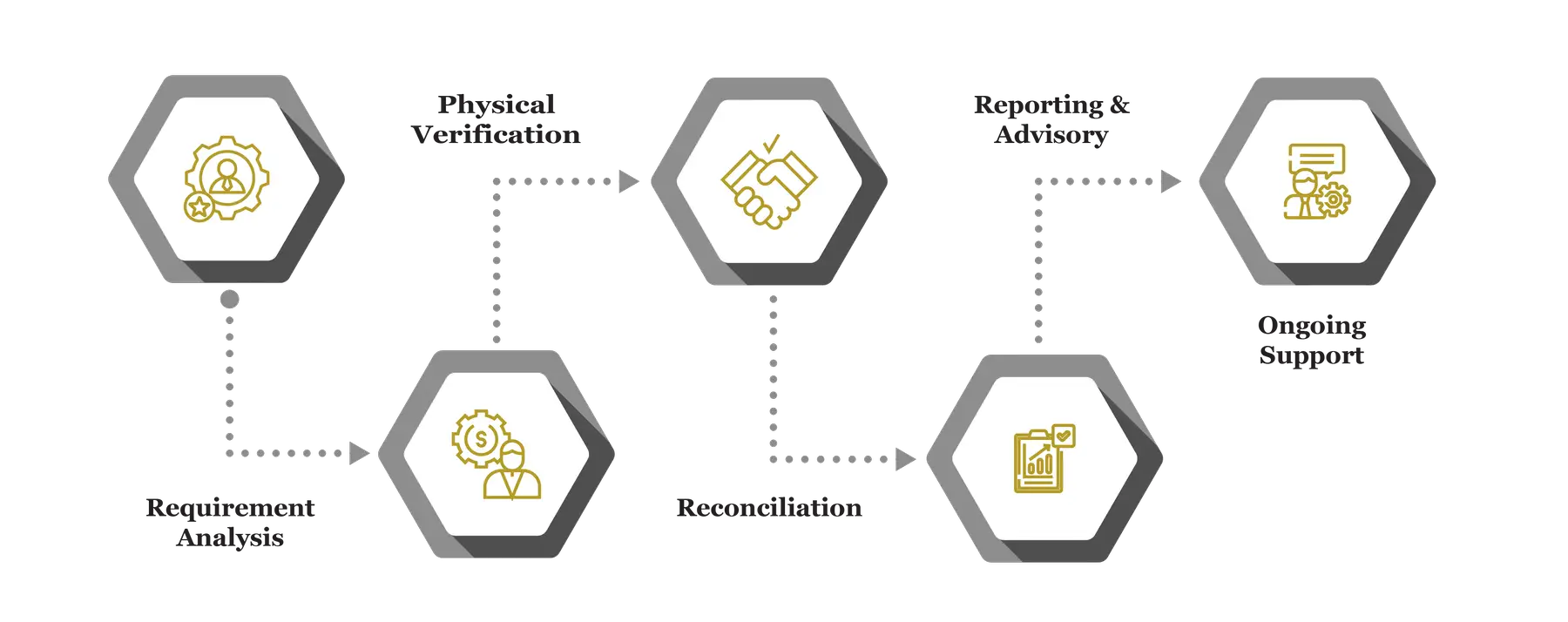
- Requirement Analysis
We review existing inventory processes, identify gaps, and design workflows tailored for accuracy and compliance. - Physical Verification
Our experts perform meticulous counts at designated locations to ensure alignment with records. - Reconciliation
Inventory quantities are compared with ledger entries, discrepancies are analyzed, and corrective measures are implemented. - Reporting & Advisory
Detailed reports and insights are shared with management, offering recommendations to optimize stock handling and reduce discrepancies. - Ongoing Support
Continuous monitoring and advisory services ensure stock processes remain efficient, accurate, and compliant.

Common Challenges and How MFD Services Solves Them
Businesses in Saudi Arabia often face inventory management challenges. MFD Services addresses these professionally:
- Discrepancies in Stock Records: Physical counts often differ from ledger balances. Our experts reconcile differences efficiently.
- Stock Mismanagement: Poor handling can lead to loss or damage. We implement controls and standard operating procedures.
- Inconsistent Counting Processes: Multiple locations may follow varied procedures. We standardize stock count assignments methods across branches.
- Limited Staff Expertise: Teams may lack knowledge in inventory verification. MFD Services provides training and ongoing support.
Book an Appointment with Us
Schedule a consultation with MFD Business Solutions today and discover how our expert Actuarial Valuation and financial consulting services can enhance the accuracy and reliability of your financial records.
Documents Required for Stock Count Assignment in Saudi Arabia
To ensure accurate and compliant stock records, businesses should maintain:
- Stock ledgers and inventory journals
- Purchase and sales invoices
- Warehouse or store records
- Previous reconciliation reports
- Internal audit checklists
Which Laws and Authorities Govern Inventory Management in Saudi Arabia
Stock verification processes must comply with regulations and internal controls. MFD Services ensures adherence to:
- SOCPA – Accounting and audit standards
- Ministry of Commerce (MoC) – Corporate governance and statutory filings
- Internal Audit Authorities – Inventory verification and compliance monitoring
- National Cybersecurity Authority – Secure handling of inventory and financial data
Cost & Pricing Overview
Pricing depends on business size, number of locations, and complexity. MFD Services provides guidance:
- Company Size: Larger operations require more extensive stock verification.
- Branches/Departments: Multi-location counting increases effort.
- Customization: Additional reporting, advisory, or cycle counts may slightly adjust costs.
Industries We Serve with Stock Count Assignment
MFD Services provides professional inventory verification across sectors:
- Retail & E-Commerce – Store and warehouse stock counts
- Manufacturing & Production – Raw material and finished goods verification
- Hospitality & Restaurants – Inventory and kitchen stock audits
- Real Estate & Construction – Material and asset tracking on sites
- SMEs & Family-Owned Businesses – Scalable and efficient inventory management solutions
Contact Us
Inventory Stock Count Audit Procedures and Their Importance
Inventory stock count audit procedures are essential for ensuring the accuracy, completeness, and reliability of inventory records. In Saudi Arabia, businesses dealing with physical goods must implement structured audit procedures to verify that actual stock matches recorded balances. Without proper inventory stock count audit procedures, companies may face discrepancies, financial misstatements, and operational inefficiencies.
MFD Services provides professional inventory stock count audit procedures in KSA by combining physical verification with systematic reconciliation processes. These procedures help businesses identify gaps, detect errors, and maintain accurate inventory records. By implementing structured audit practices, organizations can enhance transparency, improve financial reporting, and ensure compliance with SOCPA and internal audit standards.
Key Steps Involved in Inventory Stock Count Audit Procedures
Effective inventory stock count audit procedures involve a series of well-defined steps to ensure accuracy and consistency. Businesses in Saudi Arabia must follow a structured approach to validate stock levels and maintain reliable records. These procedures typically begin with planning and preparation, followed by physical verification and reconciliation.
MFD Services ensures that inventory stock count audit procedures are conducted systematically. Our experts prepare detailed count plans, assign responsibilities, and ensure proper documentation. Physical counts are performed carefully, and results are compared with ledger balances to identify discrepancies. Corrective actions are then implemented to resolve any issues, ensuring accurate and audit-ready inventory records.
Role of Inventory Audit Procedures in Financial Reporting
Inventory stock count audit procedures play a crucial role in financial reporting by ensuring that inventory values are accurate and properly recorded. In Saudi Arabia, inventory is a significant component of financial statements, especially for retail, manufacturing, and trading businesses. Any inaccuracies in inventory can directly impact profitability, cost of goods sold, and overall financial performance.
MFD Services integrates inventory stock count audit procedures into financial reporting processes to ensure accuracy and compliance. By verifying stock levels and reconciling differences, businesses can maintain reliable financial statements. This approach not only improves reporting accuracy but also strengthens confidence among stakeholders, auditors, and regulatory authorities in KSA.
How Technology Enhances Inventory Stock Count Audit Procedures
Technology plays a vital role in improving the efficiency and accuracy of inventory stock count audit procedures. In Saudi Arabia, businesses are increasingly adopting digital tools such as barcode scanners, inventory management software, and ERP systems to streamline stock counting processes. These technologies reduce manual errors and improve the speed of verification.
MFD Services leverages advanced tools and systems to enhance inventory stock count audit procedures. By integrating technology with professional expertise, businesses can achieve real-time inventory tracking and accurate reporting. This approach ensures that stock counts are performed efficiently and that discrepancies are minimized, improving overall operational performance.
Benefits of Structured Inventory Stock Count Audit Procedures
Implementing structured inventory stock count audit procedures offers several benefits for businesses in Saudi Arabia. These procedures help ensure accuracy in inventory records, reduce the risk of loss or theft, and improve overall operational efficiency. Accurate stock records also support better decision-making and financial planning.
MFD Services delivers inventory stock count audit procedures that provide measurable advantages, including improved transparency, enhanced compliance, and reliable reporting. By maintaining accurate inventory data, businesses can optimize stock levels, reduce wastage, and improve profitability. These benefits make inventory audit procedures an essential component of effective inventory management in KSA.
The Future of Inventory Audit Practices in Saudi Arabia
Stock count audit procedures is increasing. Businesses are adopting advanced technologies and standardized processes to improve accuracy and efficiency in inventory management. This shift is driven by the need for transparency, compliance, and operational excellence.
MFD Services is committed to supporting businesses in this evolving landscape by providing advanced inventory stock count audit procedures. By combining professional expertise with modern tools, we ensure that businesses maintain accurate and compliant inventory records. Companies that invest in structured audit procedures today will be better positioned to achieve long-term success and maintain financial integrity in KSA.
Why Choose MFD Services
Partnering with MFD Services ensures top-quality stock management services in Saudi Arabia:
- Licensed inventory and finance professionals
- Accurate, audit-ready documentation
- Customized processes for business size and industry
- Loss prevention and operational efficiency
- Continuous advisory and support
Note: The above-mentioned services are provided via network firms if not provided directly
Contact MFD Services for Stock Count Assignment in Saudi Arabia
Professional Stock Count Assignment services in KSA ensure accuracy, compliance, and operational efficiency. MFD Services coordinates licensed experts, reconciles inventory records, and provides actionable insights to strengthen financial control. Schedule your consultation today.
FAQ's
Audits confirm that actual stock matches recorded balances, preventing errors and losses. This ensures compliance and reliable financial reporting in Saudi Arabia.
The process includes planning, physical verification, reconciliation, and corrective actions. These steps keep records accurate and audit‑ready for smooth operations.
They verify inventory values to ensure accurate costs and profits in financial statements. Reliable reporting builds trust with auditors, regulators, and stakeholders.
Tools like barcode scanners and ERP systems reduce manual errors and speed up counts. They provide real‑time tracking, making audits faster and more accurate.
They improve accuracy, reduce risks of theft or wastage, and enhance efficiency. Businesses gain clear data for better planning, decision‑making, and profitability.