
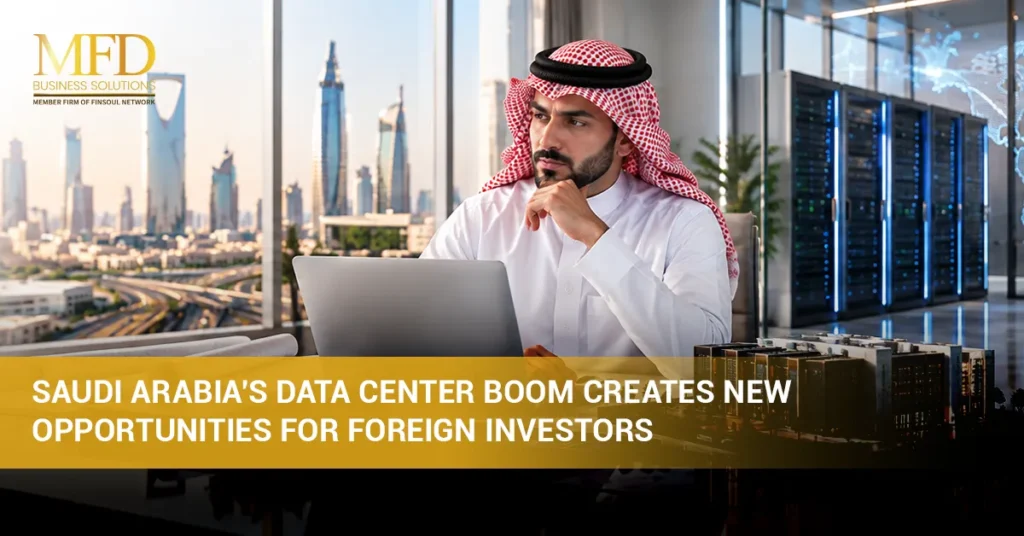
Saudi Arabia is expanding its digital infrastructure as businesses, government entities, and technology providers rely on cloud systems, artificial intelligence, online platforms, and digital services. Data centers provide the computing power, storage, connectivity, and security needed to support this growth. Technology companies in Saudi Arabia are becoming part of a growing market driven by Vision 2030, AI development, smart cities, and wider cloud adoption. For foreign investors, this creates opportunities in data centers, cloud infrastructure, power, cooling, connectivity, and cybersecurity.
MFD Services supports businesses planning expansion into Saudi Arabia through its Business Setup in Saudi Arabia services. Investors need to understand business structures, registration requirements, regulations, and market conditions before starting operations. MFD Services can help businesses review their market entry plans, understand local setup requirements, and prepare for the steps involved in establishing a presence in the Kingdom.
Why Is Saudi Arabia’s Data Center Market Growing?
Saudi Arabia’s data center market is growing as more business and government activities depend on digital systems. Banks, hospitals, retailers, telecom providers, manufacturers, government departments, and online businesses need reliable computing and storage infrastructure. Cloud computing is also increasing demand because companies are moving applications and data to hosted platforms that require secure facilities.
Artificial intelligence is another major source of demand. AI applications need significant computing power, storage, and network capacity. Saudi Arabia is also investing in digital government services, smart cities, connected infrastructure, and advanced industries. These projects create more data and require systems that can process information quickly.
Vision 2030 supports wider digital transformation and technology development, and it is one of the main forces behind businesses entering Saudi technology market today. As digital services become more common across different sectors, businesses need local infrastructure that can support performance, security, and reliable access.
How Fast Is Saudi Arabia’s Data Center Sector Expanding?
Saudi Arabia’s data center capacity has increased sharply in recent years. Government figures reported more than 467 MW of data center capacity in the first quarter of 2026, compared with 68 MW in 2021.
- Higher capacity: New facilities are being developed for cloud, AI, government, and enterprise customers.
- Large investment: More than SAR 56 billion has been invested in data centers and digital infrastructure.
- AI demand: High-performance computing is increasing demand for advanced facilities.
- Cloud growth: Cloud providers require local infrastructure to serve businesses and public-sector customers.
- New projects: Developments are being planned and built in Riyadh, NEOM, Oxagon, and other locations.
The figures show that Saudi Arabia is moving toward a larger and more advanced data center market.
What Is Creating New Opportunities for Foreign Investors?
The growth of digital services is creating opportunities across different parts of the data center industry, and technology companies in Saudi Arabia are finding new ways to take part in this expansion.
- Hyperscale facilities: Large cloud and technology providers need high-capacity facilities for computing and storage.
- Colocation: Businesses can rent space, power, cooling, and network connections instead of building their own facilities.
- AI infrastructure: AI workloads require specialized computing systems, high power capacity, and advanced cooling.
- Edge facilities: 5G, smart cities, connected industries, and IoT applications can create demand for facilities closer to users.
- Supporting services: Power equipment, cooling, network infrastructure, cybersecurity, construction, and maintenance can all create opportunities.
Investors therefore have options beyond building and operating a complete data center. They can focus on a specific part of the market that matches their capital and technical experience.
Why Is Saudi Arabia Attractive for Foreign Data Center Investors?
Saudi Arabia has several conditions that support data center investment. The Kingdom has a large domestic economy with customers across banking, healthcare, retail, telecom, government, manufacturing, and other industries. Its geographic position also provides access to markets across the Middle East, Asia, Europe, and Africa. Reliable electricity is important for data centers, and Saudi Arabia has a major energy sector that supports large infrastructure projects.
Vision 2030 is encouraging investment in digital services, AI, cloud computing, and advanced technology. Large projects in Riyadh, NEOM, and other areas are creating further demand for digital infrastructure. Government initiatives and private-sector investment are also helping the sector grow. These conditions are supporting technology investment Saudi Arabia, particularly in data centers, cloud services, AI infrastructure, and related digital systems. Foreign investors can also participate through specialist services that support data center development and operations.
Which Saudi Arabian Locations Are Attracting Data Center Investors?
Location can affect power supply, fiber connectivity, customer access, land availability, construction costs, and future expansion. Several areas are attracting data center activity from technology companies in Saudi Arabia and abroad.
- Riyadh: The capital has strong demand from government entities, banks, enterprises, cloud providers, and technology businesses.
- Dammam and the Eastern Province: Industrial activity and proximity to energy resources support large infrastructure projects.
- Jeddah: Its commercial activity and western location support demand for digital services and connectivity.
- NEOM: Technology-focused development plans are creating demand for advanced digital infrastructure.
- Oxagon: Industrial and technology projects are creating opportunities for large digital infrastructure facilities.
Investors should compare locations based on their project requirements rather than selecting a city only because it has a large existing market.
Can Foreign Investors Own Data Center Businesses in Saudi Arabia?
Saudi Arabia permits foreign ownership in many business activities, subject to the investment rules and requirements that apply to the specific activity. A foreign investor planning a data center business should identify the correct business activity and review the conditions attached to it. Investors may consider a wholly foreign-owned company, joint venture, or another suitable structure depending on the project.
The structure can depend on the business model, capital requirements, partners, customers, and regulatory obligations. Investors should also review commercial registration, employment, localization, tax, and sector-specific requirements before committing to a major data center project. MFD Services Company Formation Services in Saudi Arabia can support foreign investors with structure selection, licensing, documentation, government portal requirements, and the incorporation process. This gives investors a clearer view of the steps involved before establishing their Saudi business.
What Regulations Should Foreign Data Center Investors Know?
Foreign investors should review the regulatory requirements before starting a data center project. The exact rules can depend on the services provided, customers served, and type of data handled.
- MISA requirements: Investors should review investment registration and the business activity requirements applicable to their company.
- CST regulations: The Communications, Space & Technology Commission has regulations covering data center services.
- Personal Data Protection Law: The PDPL sets requirements for collecting, processing, storing, and transferring personal data.
- NCA controls: Applicable cybersecurity controls can affect organizations, cloud providers, and systems handling sensitive information.
- Sector-specific rules: Banking, healthcare, government, telecom, and other regulated sectors may have additional requirements.
Investors should confirm the requirements for their own project before making major commitments.
What Are the Main Risks for Foreign Investors?
Data center projects require careful financial and operational planning. Investors should consider these risks before committing capital.
- High initial costs: Land, construction, power equipment, cooling, networking, and security can require substantial investment.
- Power availability: Large facilities need reliable electricity and sufficient capacity for future expansion.
- Cooling requirements: Saudi Arabia’s climate can increase cooling requirements and operating costs.
- Regulatory obligations: Data protection, cybersecurity, investment, employment, and sector rules can affect project planning.
- Customer demand: A facility needs enough customers and realistic occupancy expectations to support its financial model.
Investors should assess both market demand and operating conditions before selecting a project.
What Should Foreign Investors Assess Before Entering Saudi Arabia’s Data Center Market?
Investors should review the commercial, technical, financial, and regulatory sides of a proposed project before making a commitment.
- Customer demand: Identify potential customers and understand their capacity, connectivity, security, and service needs.
- Power and land: Check electricity capacity, land suitability, connection timelines, and future expansion space.
- Connectivity: Review fiber availability, network providers, latency, and routes to major business locations.
- Regulatory requirements: Identify investment, data protection, cybersecurity, employment, licensing, and sector rules.
- Financial model: Estimate construction costs, energy expenses, staffing, maintenance, revenue, occupancy, financing, and expected returns.
This review can help investors decide whether to build a facility, join an existing project, or provide specialist services.
What Does the Future Hold for Saudi Arabia’s Data Center Sector?
Saudi Arabia’s data center sector is expected to remain connected to the growth of AI, cloud computing, digital government, smart cities, and connected industries. AI workloads are increasing demand for high-performance computing, while cloud platforms need facilities that can support growing numbers of users and applications. Large development projects are also creating new requirements for digital infrastructure.
Riyadh is likely to remain an important market because of its concentration of government and business activity, while NEOM, Oxagon, Dammam, and other areas can support specialized projects. Power efficiency and advanced cooling are also likely to receive greater attention as facilities become larger and computing requirements increase. The opportunity extends beyond data center ownership. Technology companies in Saudi Arabia and abroad can participate through cloud services, AI infrastructure, cybersecurity, network systems, power, cooling, engineering, construction, and facility management as Saudi Arabia continues developing its digital economy.
How Can Foreign Investors Enter Saudi Arabia’s Data Center Market?
Foreign investors can approach the Saudi data center sector through these six practical steps.
Step 1: Choose the Business Model
Decide whether the project will focus on hyperscale facilities, colocation, edge computing, AI infrastructure, cloud services, or supporting data center services.
Step 2: Research the Market
Study customer demand, existing operators, planned facilities, pricing, competitors, and areas where additional capacity may be needed.
Step 3: Select the Location
Compare Riyadh, Dammam, Jeddah, NEOM, Oxagon, and other areas based on power, land, connectivity, customers, and expansion potential.
Step 4: Review Investment and Regulatory Requirements
Identify the correct business activity and review foreign investment, registration, data protection, cybersecurity, employment, and sector requirements.
Step 5: Prepare the Technical and Financial Plan
Calculate construction costs, power consumption, cooling requirements, staffing, maintenance, connectivity costs, expected revenue, occupancy, and future expansion costs.
Step 6: Establish the Saudi Business
Complete the required registrations and approvals, establish the selected structure, arrange facilities and suppliers, hire the required workforce, and prepare the business for operations.
Our team can assist foreign businesses with Saudi market entry and business setup requirements. Its support can help investors organize the early stages of expansion and understand local requirements before starting operations.
Why Choose MFD Services for Saudi Arabia’s Data Center Market?
We help foreign investors understand the practical steps involved in entering Saudi Arabia’s growing data center market. Our team can assist with business structure selection, company registration, licensing, documentation, and local setup requirements. Support can be based on the planned activity, ownership structure, and market entry goals.
This helps businesses manage the early stages of setting up a technology or infrastructure company in Saudi Arabia. Our team can also guide investors through the requirements for establishing a legal presence in the Kingdom. For businesses exploring data centers, cloud services, AI infrastructure, or related technology activities, this support can help create a clear plan for starting operations.
Conclusion
Saudi Arabia’s data center sector is growing as AI, cloud computing, digital government, smart cities, and online business services increase demand for computing infrastructure. This expansion is creating opportunities in data centers, cloud services, AI systems, connectivity, power, cooling, cybersecurity, construction, and technical services. Riyadh, Dammam, Jeddah, NEOM, and Oxagon are attracting different types of digital infrastructure activity.
Foreign investors should assess the business model, location, costs, customer demand, ownership structure, and applicable regulations before investing. MFD Services can help businesses understand Saudi market entry and local setup requirements. Careful planning can help investors identify a suitable way to participate in the Kingdom’s growing digital infrastructure sector.
FAQs
What types of companies can benefit from Saudi Arabia’s data center growth?
Cloud providers, AI businesses, telecom companies, cybersecurity firms, infrastructure providers, engineering companies, and specialist technology suppliers can benefit from rising data center demand.
Why do AI businesses need more data center capacity?
AI applications require significant computing power, storage, networking, and cooling, especially when businesses use large models and high-performance computing systems.
How does 5G affect data center demand in Saudi Arabia?
5G supports faster connections for smart cities, connected devices, industrial systems, and digital services, which can increase demand for computing facilities closer to users.
Why is fiber connectivity important for data centers?
Strong fiber connections allow data centers to communicate quickly with businesses, cloud platforms, users, and other facilities while handling large amounts of data traffic.
Can smaller technology businesses participate in Saudi Arabia’s data center sector?
Yes. Smaller businesses can participate through specialist services such as cybersecurity, network support, cooling, equipment maintenance, software, engineering, and technical consulting.