
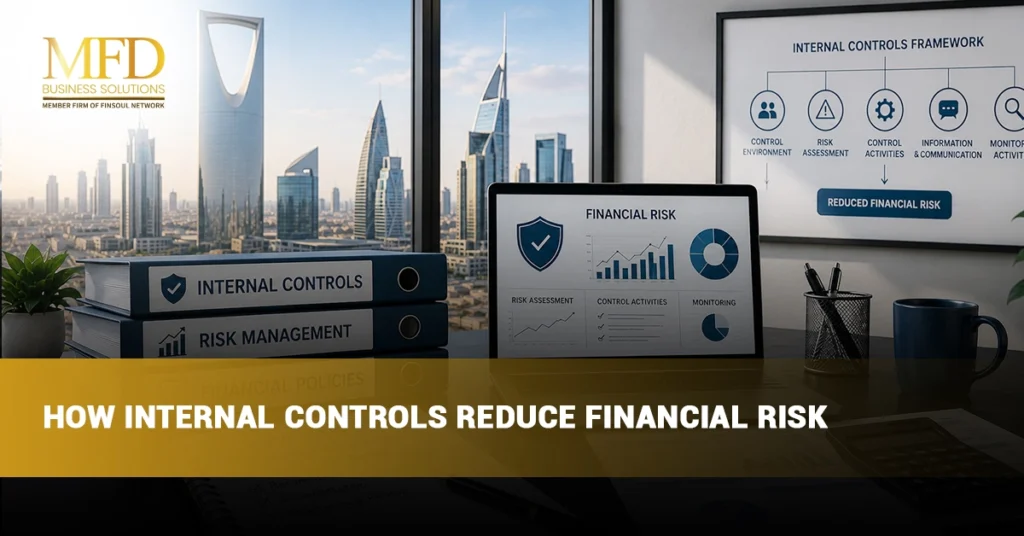
Every finance leader in the Kingdom eventually faces the same question: how can we be sure our financial data is accurate, our assets are protected, and our operations aren’t vulnerable to fraud or costly mistakes? The answer lies in implementing effective Internal Control Systems Saudi Arabia: the policies, procedures, and monitoring mechanisms that help organizations safeguard assets, ensure accurate financial reporting, improve operational efficiency, and comply with regulatory requirements. As businesses expand and financial operations become more complex, strong internal controls are essential for reducing risk and maintaining stakeholder confidence.
In Saudi Arabia’s evolving regulatory and business environment, internal control systems have become a strategic necessity rather than just a financial best practice. Weak controls can result in financial losses, compliance failures, operational inefficiencies, and reputational damage that hinder long-term growth. At MFD Services, we help organizations build practical and effective internal control frameworks that strengthen governance and support sustainable business success. This article explores how Internal Control Systems Saudi Arabia reduce financial risk and the key elements of a successful implementation.
What Are Internal Control Systems?
Internal Control Systems Saudi Arabia refer to the structured processes a company puts in place to safeguard assets, ensure accurate financial reporting, and promote operational efficiency. This isn’t just about preventing fraud, though that’s a major part of it; it also covers approval workflows, segregation of duties, reconciliation processes, and IT access controls. A well-designed system creates checkpoints throughout every financial transaction, from a simple expense claim to a multi-million riyal capital investment, so that no single person or process can quietly cause serious damage without detection.
Why Financial Risk Management Matters in Saudi Arabia
Financial Risk Management Saudi Arabia has become a board-level priority as companies navigate volatile commodity prices, currency exposure, tightening credit conditions, and increasingly complex regulatory requirements from SAMA and the CMA. Poor risk oversight doesn’t just lead to financial losses; it can trigger regulatory penalties, damage lender relationships, and erode investor trust built over years. Effective risk management practices give leadership the visibility they need to make confident decisions, rather than reacting after problems have already surfaced. This is precisely where robust internal controls earn their keep, translating risk management theory into daily operational discipline.
Who Needs Strong Internal Controls?
It’s tempting to assume this topic is only relevant to large listed companies or banks, but that isn’t the case. Family-owned businesses preparing for succession, mid-sized manufacturers scaling into new regions, and even fast-growing startups taking on their first institutional investors all need some version of Internal Control Systems Saudi Arabia in place. The scale and complexity will differ; a 20-person company doesn’t need the same layered approval matrix as a multinational, but the underlying principles of segregation of duties, documented approvals, and regular reconciliation apply just as much to a small trading company as to a listed conglomerate. Waiting until the business is large enough to “justify” controls almost always means retrofitting them under pressure, usually right when a bank, auditor, or investor starts asking questions.
7 Ways Internal Control Systems Reduce Financial Risk
1. Preventing and Detecting Fraud
One of the clearest benefits of Internal Control Systems Saudi Arabia is fraud prevention. Segregation of duties, ensuring no single employee can both initiate and approve a transaction closes off the most common avenue for internal fraud. Combined with regular reconciliations and surprise audits, these controls make it significantly harder for fraudulent activity to go unnoticed for long.
2. Improving the Accuracy of Financial Reporting
Errors in financial statements can mislead management, investors, and lenders alike. Structured review processes, approval hierarchies, and reconciliation checkpoints built into a solid control system dramatically reduce the chance of material misstatements making it into published reports, protecting both compliance standing and market confidence.
3. Strengthening Regulatory Compliance
Saudi regulators, including SAMA and the CMA, expect companies, particularly those in financial services, to maintain documented, auditable controls. A mature Financial Risk Management Saudi Arabia framework, backed by solid internal controls, makes regulatory examinations far smoother and reduces the likelihood of findings that could damage a company’s standing or license to operate.
4. Protecting Company Assets
Controls around inventory management, cash handling, and fixed asset registers prevent both theft and mismanagement. Physical safeguards paired with digital access restrictions ensure that valuable company resources are used appropriately and accounted for accurately at every stage.
5. Enabling Better Decision-Making
When leadership can trust the numbers in front of them, decisions get made faster and with more confidence. Reliable Internal Control Systems Saudi Arabia give executives accurate, timely data on cash flow, receivables, and liabilities, which is essential for everything from expansion planning to negotiating credit facilities with banks.
6. Reducing Third-Party and Vendor Risk
Strong controls extend beyond internal operations to how a company manages suppliers and contractors. Vendor approval processes, invoice matching, and periodic reviews reduce the risk of overbilling, duplicate payments, or dealing with unverified third parties a growing concern as supply chains become more complex.
7. Supporting Long-Term Financial Stability
Ultimately, disciplined risk management practices, underpinned by strong controls, protect a company’s long-term stability. Businesses with mature control environments tend to weather economic downturns, currency fluctuations, and sector-specific shocks far better than those relying on informal, ad hoc processes.
Building an Effective Internal Control Systems Framework
Designing Internal Control Systems Saudi Arabia that actually work in practice, rather than existing only on paper, typically involves a few key steps:
- Risk assessment first: identify where your organization is genuinely exposed before designing controls, rather than applying a generic checklist.
- Document clear policies: every control needs a defined owner, a documented procedure, and a specified review frequency.
- Invest in the right systems: ERP and accounting software with built-in approval workflows reduce reliance on manual, error-prone processes.
- Train employees consistently: controls only work if staff understand why they exist and follow them correctly, not just when audits are approaching.
- Test and refine regularly: internal audit reviews and periodic testing catch weaknesses before external auditors or, worse, fraudsters do.
Financial Risk Management Saudi Arabia Best Practices
Beyond the core control framework, companies serious about managing financial risk should also maintain a live risk register, run scenario planning against currency and commodity price swings, and ensure treasury functions report directly into senior leadership rather than being buried within broader finance operations. Pairing this with periodic third-party assessments helps validate that controls are functioning as designed, not just as documented. It’s also worth revisiting these practices whenever the business enters a new market, launches a new product line, or takes on new lenders, since each of these events changes the organization’s risk profile in ways that older controls may not have anticipated.
Common Mistakes Companies Make
Many organizations establish internal controls but struggle with effective implementation. Some of the most common mistakes include:
- Treating internal controls as a one-time project instead of an ongoing process that requires continuous monitoring and improvement.
- Failing to update control procedures as the business grows, expands into new markets, or changes its operations.
- Neglecting IT and cybersecurity controls, even though digital risks are increasingly connected to financial and operational risks.
- Not reviewing controls after major business changes, such as mergers, system implementations, or leadership transitions, leaving outdated processes and unnoticed control gaps.
- Over-engineering control frameworks, making procedures so complex that employees create workarounds instead of following them consistently.
- Failing to conduct regular reviews of Internal Control Systems Saudi Arabia, rather than evaluating and improving the framework at least annually.
Final Thoughts
Strong Internal Control Systems Saudi Arabia don’t eliminate risk entirely, but they make it visible, manageable, and far less likely to cause serious damage. Combined with disciplined financial risk management, they give leadership the confidence to grow the business without losing sight of what’s happening beneath the surface. If your organization hasn’t reviewed its control environment recently, MFD Services can help assess where the gaps are and design a framework tailored to your size, sector, and risk profile. A well-built control environment, developed with the right partner, is one of the most cost-effective investments a company can make in its own resilience.
Frequently Asked Questions
What are internal controls in financial management?
Internal controls are the policies and procedures companies use to safeguard assets, ensure accurate financial reporting, and prevent fraud or error within financial operations.
Why are internal controls important for reducing financial risk?
They create checkpoints throughout financial processes, such as approvals, reconciliations, and segregation of duties, that catch errors and prevent fraud before they cause significant damage.
What are the main types of internal controls?
The three broad categories are preventive controls (stopping errors before they happen), detective controls (identifying issues after the fact), and corrective controls (fixing problems once found).
How often should internal controls be reviewed?
Most organizations review and test their controls at least annually, with additional reviews triggered by major changes such as new systems, mergers, or significant growth.
Who is responsible for internal controls in a company?
While senior management and the board hold ultimate responsibility, internal audit, finance, and compliance teams typically design, implement, and monitor controls on a day-to-day basis.