
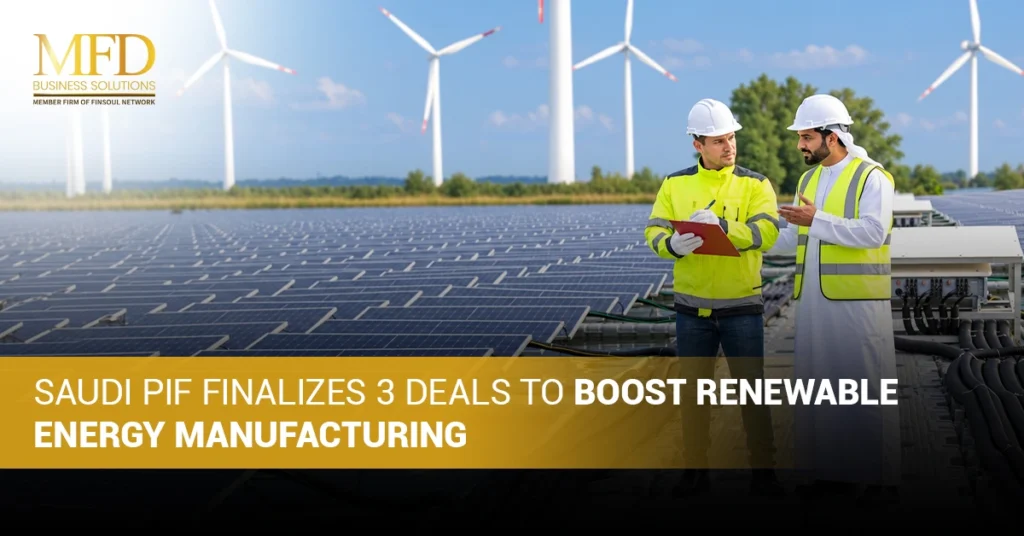
Saudi Arabia is taking bold steps to build a strong clean energy industry at home. The Public Investment Fund, known as PIF, has recently signed three major deals aimed at growing local renewable energy production. These agreements cover wind turbines, solar panels, and solar wafers, bringing global manufacturing expertise directly into the Kingdom. This move is part of a bigger plan to reduce reliance on imported equipment and build a self-sufficient energy sector.
The Saudi PIF Renewable Energy plans are reshaping how the country approaches clean power, giving local industries a bigger role in the years ahead. For businesses and readers who want to understand what these deals mean, MFD Services breaks down the details in simple terms below, covering each partnership, its scale, and why it matters for Saudi Arabia’s future.
What Are the Three Renewable Energy Deals Signed by PIF?
PIF’s latest agreements show how serious the Kingdom is about growing its clean energy base. The Saudi PIF Renewable Energy deals mark a turning point for local industry, bringing together international partners and domestic capacity in one coordinated effort.
- PIF worked through its subsidiary, the Renewable Energy Localization Company, also called RELC, to lead all three partnerships and manage local manufacturing plans
- Envision Energy signed on to build wind turbine parts inside Saudi Arabia, adding a new layer to the country’s wind power ambitions
- Jinko Solar joined to set up solar cell and module production lines, strengthening the Kingdom’s solar equipment supply
- TCL Zhonghuan and LUMETECH agreed to produce solar ingots and wafers, covering an earlier stage of the solar manufacturing chain
- Together, the three deals are expected to create a combined production capacity large enough to support Saudi Arabia’s growing renewable energy targets while keeping majority ownership within the Kingdom
These partnerships are structured so that Saudi entities hold a controlling stake, while foreign partners bring in technology and manufacturing know how. This balance allows the country to grow its own industrial base rather than simply importing finished products. MFD Services will keep an eye on how these ownership structures evolve as the projects move forward.
How Will the Envision Energy Deal Support Wind Manufacturing in Saudi Arabia?
The Envision Energy partnership is one of the most important pieces of this new manufacturing push. It focuses on building the parts needed for wind turbines right inside the Kingdom.
- Envision Energy, a well known name in wind technology, will work with RELC to set up local production facilities for turbine components
- The deal covers manufacturing of major wind turbine parts, reducing the need to bring these heavy components in from overseas
- Once fully running, the facility is expected to reach an annual production capacity of around 4 gigawatts, a significant volume for the regional market
- Local suppliers and workers will benefit as the project builds a supply chain around raw materials, parts, and assembly work inside Saudi Arabia
- This step in the Saudi PIF Renewable Energy manufacturing push is expected to lower costs for future wind projects and speed up construction timelines across the country
Wind energy has been growing steadily in Saudi Arabia, and having local manufacturing means projects can move faster without waiting on long international shipping schedules. It also opens the door for more skilled jobs within the country.
What Does the Jinko Solar Deal Mean for Saudi Solar Manufacturing?
Solar power is central to Saudi Arabia’s clean energy goals, and the Jinko Solar agreement adds real strength to that plan. This deal focuses on the middle stage of solar production, turning raw materials into finished panels.
- Jinko Solar, one of the largest solar panel makers in the world, has partnered with RELC to build local production lines
- The agreement includes manufacturing of photovoltaic cells, the core component that converts sunlight into electricity
- It also covers full solar module assembly, meaning finished panels can be produced and shipped directly from inside the Kingdom
- The facility is expected to reach an annual production capacity of about 10 gigawatts, making it one of the larger solar manufacturing sites in the region
- This partnership is part of the wider Saudi PIF Renewable Energy strategy to make the country a hub for solar equipment, not just a buyer of it
For Saudi Arabia’s solar industry, this deal means shorter supply chains, more local jobs, and a steady source of panels for the country’s growing number of solar farms and rooftop projects.
What Will the TCL Zhonghuan and LUMETECH Deal Produce?
The third deal fills an important gap in the solar supply chain by focusing on ingots and wafers, the raw building blocks used before solar cells are even made. TCL Zhonghuan, a major name in solar wafer production, has partnered with LUMETECH and RELC to set up this stage of manufacturing inside Saudi Arabia. The facility is expected to reach an annual production capacity of around 20 gigawatts, which is the largest of the three announced projects, reflecting the scale of the Saudi PIF Renewable Energy investment plan.
By producing ingots and wafers locally, the Kingdom reduces its dependence on imported raw materials, which have traditionally come from a small number of countries. This deal connects directly with the Jinko Solar project, since wafers made here can feed straight into local cell and module production. Having this early stage of the supply chain inside the country strengthens the entire solar manufacturing base and supports long term price stability for future projects across Saudi Arabia.
Why Is Saudi Arabia Localizing Renewable Energy Manufacturing?
Saudi Arabia’s push to build clean energy equipment at home is not a random decision. The Saudi PIF Renewable Energy approach focuses on turning the country into a genuine manufacturing hub, not just a market for imported technology. As MFD Services often points out, this kind of long term planning is what sets successful energy strategies apart.
Reducing Dependence on Imported Renewable Components
Bringing in wind and solar parts from other countries can be slow and costly. Local production helps avoid shipping delays, currency risks, and supply shortages, giving the Kingdom more control over its energy projects.
Building a Local Renewable Energy Supply Chain
A full supply chain, from raw wafers to finished turbine parts, means fewer gaps in production. This directly supports Renewable Energy Manufacturing Saudi Arabia goals by keeping more of the process inside national borders.
Supporting Saudi Industrial Development
These factories bring new industrial activity to the country, adding to sectors beyond oil and gas. This fits within the Kingdom’s broader plan to diversify its economy through PIF Investment Saudi Arabia projects across multiple industries.
Creating Opportunities for Local Businesses
Local suppliers, contractors, and service providers all gain from these large projects. Smaller businesses can find new roles supporting logistics, maintenance, and raw material supply for the bigger manufacturing sites.
Supporting Renewable Energy Expansion
More local manufacturing means faster and cheaper access to equipment, which helps Saudi Arabia keep building new wind and solar projects without waiting on long international supply lines.
What Do the Three PIF Deals Mean for Saudi Arabia?
These three deals are more than just business agreements. They connect directly to Vision 2030, the Kingdom’s long term plan to diversify its economy and reduce dependence on oil revenue. By building wind and solar manufacturing at home, Saudi Arabia is setting itself up for steady renewable energy growth over the coming decade. Local manufacturing also supports wider industrial development, since factories, suppliers, and logistics networks all grow together around these projects.
Over time, this could turn the Kingdom into a regional export hub for clean energy equipment, not just a user of it. The long term economic impact includes new jobs, stronger local industry, and reduced spending on imported technology. For a country investing heavily in solar and wind power, having the equipment made locally is a smart way to keep costs manageable while building expertise that can last for generations.
What Is PIF’s Renewable Energy Strategy?
PIF’s approach goes beyond these three deals. The Saudi PIF Renewable Energy strategy rests on a broader plan to grow the entire clean energy sector from the ground up.
- Continued investment in renewable energy projects, including large solar and wind farms across the Kingdom
- A clear focus on manufacturing localization, so equipment is built inside Saudi Arabia rather than shipped in from abroad
- International partnerships with established manufacturers who bring technology, training, and proven production methods
- Growing participation from the local private sector, giving Saudi companies a bigger role in supply chains and services
- Long term plans for further renewable energy development, supporting the Kingdom’s wider clean energy and diversification goals
This strategy shows that PIF is not just funding projects, it is building an entire industry that can support Saudi Arabia’s energy needs for decades to come. MFD Services sees this as one of the clearest signs yet of how seriously the Kingdom is treating its clean energy future.
Conclusion
Saudi Arabia’s three new renewable energy manufacturing deals mark a major step toward energy self sufficiency. From wind turbine parts with Envision Energy, to solar cells and modules with Jinko Solar, to wafers and ingots with TCL Zhonghuan and LUMETECH, each agreement fills a key part of the clean energy supply chain. Together, they support Vision 2030 goals, create local jobs, and reduce reliance on imported equipment. As these projects move forward, they will shape how Saudi Arabia builds and powers its future.
MFD Services will continue tracking these developments, helping readers stay informed about the Kingdom’s growing renewable energy industry and what it means for businesses and communities across the region. MFD Services remains a helpful source for clear, simple updates on Saudi Arabia’s energy sector.
FAQs
What are the three renewable energy deals signed by PIF?
PIF signed deals with Envision Energy for wind turbine parts, Jinko Solar for solar cells and modules, and TCL Zhonghuan with LUMETECH for solar wafers and ingots, all aimed at building local manufacturing capacity in Saudi Arabia.
What is RELC and how is it connected to these deals?
RELC stands for the Renewable Energy Localization Company, a PIF subsidiary that leads local manufacturing efforts. It managed all three partnerships to support Renewable Energy Manufacturing Saudi Arabia goals under PIF’s broader strategy.
How much production capacity will these deals create?
Combined, the three deals aim for roughly 4 gigawatts of wind component capacity, 10 gigawatts of solar cell and module capacity, and 20 gigawatts of wafer and ingot capacity each year.
Why is Saudi Arabia focusing on local renewable energy manufacturing?
Local manufacturing reduces dependence on imports, supports industrial growth, creates jobs, and strengthens PIF Investment Saudi Arabia efforts to diversify the economy away from oil under Vision 2030.
How do these deals support Vision 2030 goals?
These agreements build local industry, support renewable energy expansion, and create long term economic value, all of which align directly with Vision 2030’s aim to diversify and modernize the Saudi economy.