
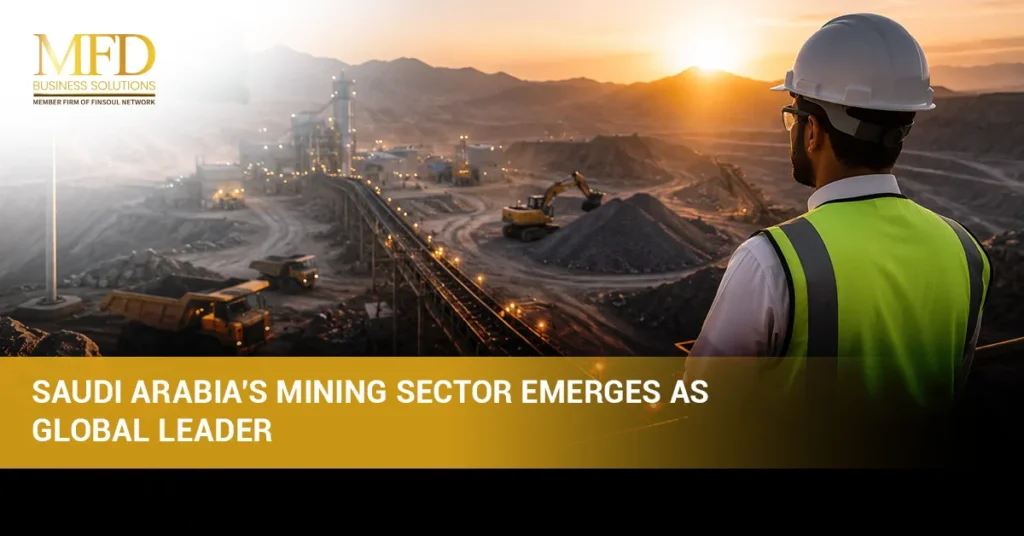
For decades, the Kingdom’s economy told one story: oil. Today, a new chapter is being written, and it is being read closely by investors, engineers, and governments across the world. The Mining Sector Saudi Arabia is no longer a side note in the national economy it is fast becoming one of its central pillars.
At MFD Services, we’ve been tracking this transformation closely, and the momentum behind it is impossible to ignore. With Vision 2030 accelerating economic diversification, mining is emerging as a major source of investment, jobs, and industrial growth. The Kingdom’s vast mineral resources are attracting global attention and creating new opportunities across the mining value chain.
Beyond Oil: The Rise of the Mining Sector Saudi Arabia
Saudi Arabia’s mining sector is rapidly expanding as the Kingdom uses its vast mineral resources to support economic diversification, attract international investment, and strengthen its industrial capabilities under Vision 2030.
Several key mining sectors are driving this transformation:
- Gold: Gold remains one of Saudi Arabia’s most important mineral resources, with ongoing exploration and development projects creating opportunities for investors, mining companies, and supporting industries across the Kingdom.
- Copper: Copper is gaining importance because of its role in construction, manufacturing, renewable energy, and electrical infrastructure, making it an increasingly attractive area for exploration and long-term investment.
- Phosphate: Phosphate is a strategic resource for Saudi Arabia, supporting fertilizer production and exports while strengthening the Kingdom’s position in global agricultural and industrial supply chains.
- Bauxite: Bauxite supports Saudi Arabia’s expanding aluminum industry and contributes to downstream manufacturing, helping the Kingdom develop greater value from its mineral resources rather than relying primarily on raw material exports.
- Rare Earth Elements: Rare earth elements are receiving greater attention because of their importance in electric vehicles, electronics, renewable energy technologies, and other advanced industries shaping future global supply chains.
- Mining Infrastructure: Investment in railways, roads, ports, power networks, and processing facilities is helping connect remote mineral deposits with industrial centers and export markets, supporting broader sector development.
Inside the Boom: Key Numbers to Know
The scale of growth becomes clearer when you look at the figures directly. The table below summarizes some of the sector’s most notable recent milestones. These figures highlight the rapid development of the Mining Sector Saudi Arabia and its growing importance to the Kingdom’s economic diversification strategy.
| Metric | Figure | Significance |
| Estimated mineral wealth | SAR 9.375 trillion+ | One of the largest untapped reserves globally |
| Mining sector GDP target (2030) | SAR 281.25 billion | Triple the current contribution |
| New exploration licenses (2023–24) | 300+ | Fastest licensing pace in the region’s history |
| Foreign investment pledges | SAR 675 billion+ | Announced at Future Minerals Forum events |
These numbers aren’t projections pulled from thin air they reflect real licensing activity, real signed agreements, and real infrastructure being built in the Northern Border and Al-Jalamid regions.
What’s Driving Saudi Mining Investment
Capital doesn’t move without confidence, and confidence in Saudi Mining Investment has been building steadily. Three forces stand out. First, government-backed funding vehicles like Manara Minerals are co-investing directly in global mining assets, signaling that Riyadh sees this as a long-term strategic bet, not a passing trend. Second, the Future Minerals Forum has become a genuine deal-making venue rather than a ceremonial conference, drawing executives from BHP, Ivanhoe, and dozens of mid-tier explorers. Third, infrastructure spending on rail, ports, and power is lowering the cost of extracting and exporting minerals that were previously stranded far from any usable logistics network.
Together, these factors have made Saudi Mining Investment one of the more compelling stories in global resource markets, particularly for companies looking to diversify supply chains away from traditional mining hubs.
Global Players Taking Notice
International interest hasn’t stayed theoretical. Major firms across the Mining Industry Saudi Arabia ecosystem from exploration specialists to heavy equipment manufacturers are opening regional offices, signing joint ventures, and bidding on exploration blocks. This isn’t limited to gold and copper either; battery-metal demand is pulling attention toward Saudi phosphate and rare earth deposits as electric vehicle supply chains look for new, geopolitically stable sources.
Analysts within the Mining Industry Saudi Arabia space increasingly compare the Kingdom’s trajectory to Australia’s mining boom of the early 2000s a resource-rich nation moving decisively to convert geological advantage into industrial capacity before global competitors catch up.
Challenges Still on the Table
Saudi Arabia’s mining sector has strong growth potential, but several challenges could influence how quickly the industry reaches maturity:
- Water Scarcity: Limited water availability in arid mining regions can make mineral processing more complex and increase operational costs.
- Skilled Workforce: A shortage of specialized mining professionals is encouraging greater investment in technical training, education, and partnerships with international universities.
- Commodity Price Volatility: Global fluctuations in mineral prices can affect project profitability, making careful financial planning essential for long-term investments.
- Logistics & Infrastructure: Moving minerals from remote desert sites to processing facilities and ports remains a major challenge, requiring continued investment in roads, railways, and transport networks.
- Environmental Stewardship: As mining activity expands, regulators and operators must maintain strong reclamation, emissions, and environmental standards that align with international ESG expectations.
- Long-Term Sustainability: Successfully balancing investment, infrastructure, environmental protection, and workforce development will determine whether current growth develops into a mature, self-sustaining mining economy.
How It Compares to Other Mining Nations
Investors naturally benchmark new opportunities against established markets, and the Mining Sector Saudi Arabia holds up well in that comparison. Australia and Chile remain the world’s dominant mining economies, but both face rising extraction costs, aging infrastructure, and, in Chile’s case, political uncertainty around resource nationalization. Saudi Arabia, by contrast, is building its mining framework almost from scratch, which means newer infrastructure, modern regulatory design, and fewer legacy disputes to untangle.
That said, scale still matters. The Mining Industry Saudi Arabia ecosystem is nowhere near the size of Australia’s, and it will take years of sustained investment before output volumes come close. What the Kingdom offers instead is growth potential the kind that attracts investors looking for the next major mining story rather than incremental returns in a mature market.
What This Means for the Region
A stronger mining base doesn’t just benefit Saudi Arabia in isolation. It reshapes regional supply chains, creates thousands of technical jobs, and positions the Gulf as a serious alternative source for minerals the world needs for renewable energy and electronics manufacturing. Neighboring economies are already watching closely, some exploring similar regulatory reforms of their own.
Universities across the region are also adjusting their curricula, adding geology, metallurgy, and mining engineering programs to meet future workforce demand. Vocational training centers near key extraction sites are producing certified technicians faster than before, gradually closing the skills gap that once slowed project timelines. If this pace continues, the Gulf could become a genuine training hub for mining talent, not just a source of raw material exports, which would further strengthen its long-term standing in global resource markets.
Final Thoughts
The Mining Sector Saudi Arabia has shifted from a quiet diversification goal to one of the most closely watched resource stories in the world. With regulatory reform, serious capital commitments, and growing international partnerships, the Kingdom is building a mining economy meant to last well beyond any single commodity cycle.
As exploration expands and infrastructure continues to develop, new opportunities are emerging across minerals, processing, technology, and supporting services. The sector’s progress will also play an important role in creating jobs, strengthening local industries, and supporting Saudi Arabia’s broader Vision 2030 objectives.
MFD Services will continue monitoring developments across the Mining Sector Saudi Arabia, helping businesses and investors understand emerging opportunities and make sense of what comes next.
Frequently Asked Questions
Why is Saudi Arabia investing so heavily in mining?
The Kingdom is diversifying away from oil dependency under Vision 2030, and its untapped mineral wealth offers a natural, high-value growth avenue.
Which minerals matter most to Saudi Arabia’s mining growth?
Gold, copper, phosphate, bauxite, and rare earth elements are the primary focus, with phosphate and rare earths gaining extra attention due to EV supply chains.
Is it easy for foreign companies to invest in Saudi mining?
Licensing has become significantly faster since the 2021 Mining Investment Law, though companies still need to navigate local partnership and compliance requirements.
What role does the Future Minerals Forum play?
It has become a major annual venue where governments, investors, and mining companies negotiate real deals rather than simply exchanging ideas.
What are the biggest risks facing the sector?
Water availability, a limited skilled workforce, and global commodity price swings remain the sector’s most pressing challenges going forward.