
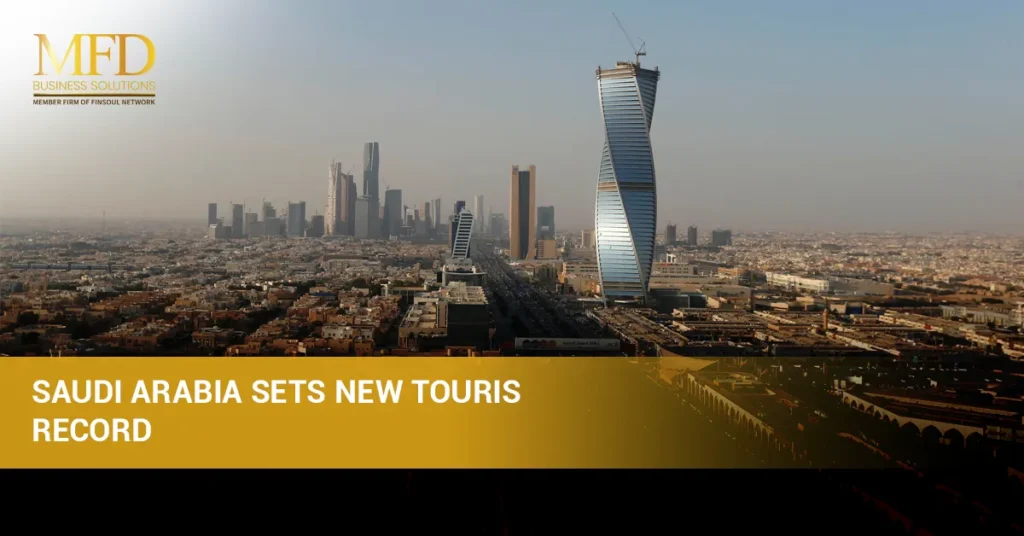
The Kingdom has just entered the headlines again, and this time it’s for good reason. Saudi Arabia Tourism has hit an all-time high, with visitor numbers, hospitality revenue, and international arrivals climbing past every previous benchmark. Analysts at MFD Services have been tracking this shift closely, and the data tells a clear story: the country is no longer an emerging destination; it’s a mainstream one. Every quarter, fresh figures reinforce the same trend, and Saudi Arabia Tourism is quickly becoming a reference point for how a nation can reposition itself on the global travel map in a short span of time. In this piece, we break down what the record actually means, why it happened, and where things are headed next.
A Landmark Year for the Kingdom
For years, Saudi Arabia Tourism was treated as a long-term bet rather than a near-term reality. That has changed. The most recent figures show tens of millions of visitors entering the country annually, a number that would have seemed unrealistic a decade ago. Giga-projects, eased visa rules, and a coordinated national push have turned ambition into measurable output.
What makes this record different from earlier milestones is consistency. Growth isn’t coming from a single event or a one-off spike in religious travel. It’s spread across leisure, business, cultural, and adventure segments, which suggests the momentum behind Saudi Arabia Tourism is structural rather than seasonal.
Government data released this year shows arrivals rising in nearly every quarter, not just during peak seasons. That kind of steady curve is exactly what economists look for when deciding whether a boom is temporary or the start of a longer cycle. For Saudi Arabia Tourism, most indicators point toward the latter.
Understanding Saudi Tourism Growth
Saudi Tourism Growth didn’t happen by accident. It’s the result of deliberate policy choices made over the past several years: an e-visa system that lets travelers apply online in minutes, new international flight routes connecting Riyadh and Jeddah to dozens of cities, and billions poured into hotels, entertainment districts, and heritage restoration.
The government’s tourism strategy also shifted focus from volume alone to spending per visitor. Luxury resorts on the Red Sea coast, boutique desert experiences, and high-end cultural tours are pulling in travelers who stay longer and spend more, which strengthens Saudi Tourism Growth in ways that raw arrival numbers don’t fully capture.
Domestic travel has played a role too. As more Saudis choose to holiday within their own borders, the sector gets a steady baseline of demand that cushions it against global travel slowdowns.
Private sector participation has also accelerated. International hotel chains, tour operators, and event organizers are now competing for space in a market that, only a few years ago, they largely overlooked. That competition is pushing up service quality across the board, which in turn feeds back into stronger Saudi Arabia Tourism numbers.
Why Visit Saudi Arabia Is Trending
The phrase Visit Saudi Arabia has become one of the most searched travel terms in the region, and it’s easy to see why. AlUla’s ancient rock formations, the futuristic vision behind NEOM, the Red Sea’s untouched reefs, and Riyadh’s rapidly modernizing skyline all offer something genuinely different from typical Gulf itineraries.
Marketing campaigns encouraging people to Visit Saudi Arabia have leaned into this contrast: old and new, desert and ocean, heritage and innovation. Global influencers, film productions, and international sporting events have all been used as tools to put the destination on travelers’ radars in a way that paid advertising alone couldn’t achieve.
There’s also a practical angle. Compared to some neighboring destinations, Saudi Arabia currently offers more untouched, less crowded experiences, which appeals to travelers looking for something beyond the usual tourist trail. As word spreads through traveler reviews and social media, the campaign to Visit Saudi Arabia is increasingly being driven by visitors themselves rather than by government marketing alone, a sign that the destination’s reputation is starting to sustain itself organically.
Key Tourism Milestones at a Glance
| Metric | Recent Performance | Significance |
| Annual international visitors | Tens of millions, a new national high | Confirms sustained demand |
| Tourism’s share of GDP | Rising steadily year over year | Signals economic diversification |
| New hotel rooms added | Thousands added across major cities | Supports higher visitor capacity |
| International flight routes | Dozens of new connections launched | Improves global accessibility |
| Giga-project openings | Multiple destinations now operational | Expands the experience offering |
This table reflects the broad base behind the record; it isn’t one number moving, it’s several moving together.
The Economic Ripple Effect
Every visitor arriving under the current wave of Saudi Arabia Tourism touches far more than the hotel and airline industries. Restaurants, local retailers, tour guides, event organizers, and transport providers all see a share of the spending. Construction firms benefit from the ongoing build-out of resorts and attractions, and small businesses in cities like AlUla and Jeddah are reporting stronger footfall than they’ve seen in years.
This diversification matters because it reduces the Kingdom’s historic reliance on oil revenue. Tourism is now viewed internally as one of the clearest examples of Vision 2030’s diversification goals actually translating into results, rather than staying on paper. That’s part of why officials keep pointing back to this record whenever they discuss the broader economic transformation underway.
What This Means for the Region
A record like this doesn’t stay contained within one country’s borders. Neighboring destinations are already adjusting pricing, marketing, and infrastructure investment in response to the competitive pressure. Airlines are adding capacity, and regional hospitality groups are expanding their footprint inside the Kingdom to capture a share of the demand.
For investors and businesses, the message is straightforward: the sector has moved past the “wait and see” stage. Hotel groups, tour operators, and logistics companies are treating Saudi Arabia as a core market rather than a speculative one. Franchise agreements, joint ventures, and new regional headquarters are being announced at a pace that would have been hard to imagine just five years ago, and that pace itself is now part of the story.
Challenges That Could Slow Progress
Records are worth celebrating, but sustaining them is harder than setting them. As Saudi Arabia’s tourism sector continues to expand, several challenges will need careful attention to maintain this momentum.
- Infrastructure: Some secondary cities still need more hotels, transport, and tourism facilities to handle growing visitor numbers.
- Seasonal Heat: Extreme summer temperatures can limit outdoor tourism during parts of the year.
- Workforce Training: Hospitality and tourism sectors need to train enough skilled workers to keep up with rising demand.
- Cultural & Natural Preservation: Rapid development must be balanced with protecting the cultural and natural sites that attract visitors.
- Sustainability: Water management, air quality, and construction-related environmental concerns will require continued attention.
- Long-Term Growth: These challenges will determine whether the current tourism record becomes a new normal or simply a temporary peak. Continued cooperation between the government, private sector, and local communities will be essential.
Final Thoughts
The Kingdom’s tourism record isn’t a one-time headline; it’s the visible result of years of planning finally converging. From new attractions to smoother entry processes, every piece of the puzzle has been engineered to support this growth. As MFD Services continues to monitor the sector, one thing is clear: this record is a checkpoint, not a ceiling, and the next few years will show whether the Kingdom can keep building on it. For businesses, investors, and travelers alike, the story of this record is really just the opening chapter of a much longer transformation.
Frequently Asked Questions
What is driving the recent tourism record in Saudi Arabia?
A mix of eased visa access, new flight routes, major infrastructure investment, and global marketing campaigns has pushed visitor numbers to an all-time high.
Is it easy for international travelers to get a visa?
Yes, most eligible nationalities can now apply through a straightforward e-visa system that takes only minutes to complete online.
What are the most popular destinations within the country?
AlUla, Riyadh, Jeddah, the Red Sea coast, and NEOM are among the most searched and visited spots by international travelers.
Does this tourism growth actually benefit the local economy?
Yes, tourism now contributes a growing share of national GDP and supports jobs across hospitality, transport, retail, and construction.
Is now a good time to visit Saudi Arabia?
Many travelers are visiting now specifically because sites remain less crowded compared to more established global destinations, while infrastructure keeps improving.