
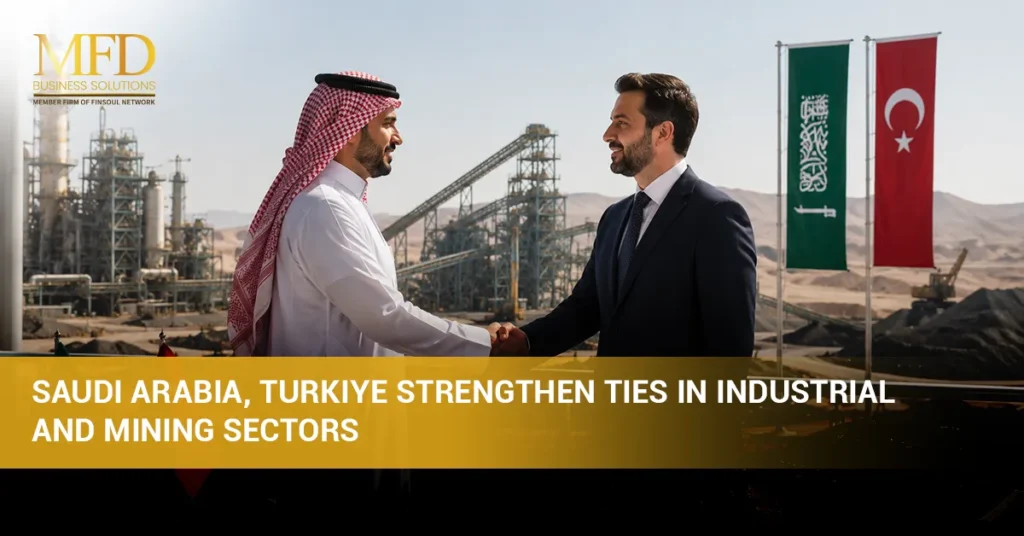
Two of the region’s most active economies are deepening their working relationship, and the latest round of talks has put Saudi Turkiye Industrial Cooperation firmly in the spotlight. Officials from both sides met to expand joint projects spanning manufacturing, resource development, and cross-border trade. MFD Services has been following the shift closely, noting that this round of engagement looks more structured and more commercially focused than previous rounds of dialogue between the two governments.
Below, we break the development down into five themes: what was agreed, why mining sits at the center of it, what it means for bilateral trade, what it means for businesses, and where Saudi Turkiye Industrial Cooperation goes from here.
What the Latest Talks Actually Covered
The current round of discussions goes beyond ceremonial diplomacy. Delegations reportedly worked through frameworks for joint industrial ventures, technical standards alignment, and investment protections the unglamorous groundwork that actually determines whether cross-border projects succeed.
This is the essence of Saudi Turkiye Industrial Cooperation: less about headline announcements, more about the regulatory scaffolding that lets private companies on both sides actually do business together.
Key Areas Covered
- Joint industrial ventures between companies from both countries
- Technical standards alignment to simplify cross-border manufacturing
- Investment protections to reduce risks for participating businesses
- Sector-specific working groups to develop practical action plans
- Cross-border business facilitation to support future industrial projects
Turkish firms bring decades of manufacturing and construction experience to the table, while Saudi partners bring capital, land, and access to a fast-growing domestic market. That complementary fit is a big part of why officials describe the current phase of talks as more advanced than earlier attempts at closer ties.
It also helps that both governments have set up dedicated working groups to keep the momentum going between high-level meetings. Rather than revisiting the same broad commitments every time officials meet, these groups are reportedly tasked with turning general Saudi Turkiye Industrial Cooperation principles into specific, sector-by-sector action plans.
This structure could ultimately determine whether the agreements produce real projects or simply another joint statement.
Why the Mining Sector Is Central to This Push
If there’s one theme that stands out from the broader industrial agenda, it’s minerals. The Saudi Mining Sector has become a national priority in its own right, with the Kingdom sitting on substantial untapped mineral wealth including copper, gold, phosphate, and rare earth elements.
Turkiye, meanwhile, has expertise in mining operations, processing technology, and heavy equipment manufacturing that Saudi Arabia is actively seeking to develop.
Talks reportedly touched on joint exploration ventures, technology transfer for extraction and processing, and potential investment in mineral processing facilities on Saudi soil.
For a Saudi Mining Sector still in the early stages of large-scale development, partnering with an experienced operator like Turkiye offers a faster route to building out capacity than starting from zero.
Mining Cooperation Snapshot
| Area of Focus | Turkiye’s Contribution | Saudi Arabia’s Contribution |
| Exploration | Geological survey expertise | Access to untapped reserves |
| Processing | Refining and smelting technology | Land and industrial infrastructure |
| Equipment | Heavy machinery manufacturing | Capital investment |
| Workforce | Technical training programs | Domestic labor pipeline |
There’s a strategic logic here too. Diversifying away from oil revenue means building alternative export industries, and minerals are one of the sectors where Saudi Arabia has significant untapped geological potential.
Strengthening the Saudi Mining Sector through foreign technical partnerships could accelerate that diversification. It is also a clear example of what Saudi Turkiye Industrial Cooperation looks like in practice capital and resources on one side, combined with industrial and operational expertise on the other.
The Bilateral Trade Picture
Stepping back from mining specifically, the broader Saudi Turkiye Relations dynamic has been on an upward trajectory for several years, with trade volumes climbing steadily even through periods of regional uncertainty. Construction materials, machinery, textiles, and food products have traditionally made up a large share of Turkish exports to the Kingdom, while Saudi Arabia has exported petrochemicals and related products in the other direction.
What’s changing now is the composition of that trade. Instead of simple import-export flows, both governments are pushing toward joint production goods manufactured collaboratively rather than shipped finished from one country to the other. That shift, if it holds, would mark a meaningful evolution in Saudi Turkiye Relations, moving the relationship from a trading partnership toward something closer to an industrial alliance.
Currency and payment mechanisms have also come up in past discussions, with both sides exploring ways to make cross-border transactions smoother for businesses operating in both markets. Smoother payment rails tend to matter more to mid-sized exporters than large announcements do, since they directly affect day-to-day operating costs.
Trade officials from both countries have also flagged customs harmonization as a near-term priority. Aligning documentation standards and inspection procedures sounds minor, but it’s often the single biggest source of delay for companies trying to move goods across the border on a regular basis. Progress here would make the practical side of Saudi Turkiye Industrial Cooperation far easier to sustain once the larger industrial projects are up and running.
What Saudi Turkiye Relations Mean for Businesses on Both Sides
For companies already active in either market, the practical takeaway is straightforward: the regulatory environment for cross-border industrial projects appears to be getting friendlier. Investment protection frameworks can reduce risk for joint ventures, while standards alignment can lower the compliance burden for businesses operating across both markets.
Key Business Opportunities
- Joint Ventures: Companies can explore partnerships and shared operations with businesses in Saudi Arabia and Turkiye.
- Investment Protection: Clearer investment frameworks can help reduce risks for companies considering cross-border projects.
- Standards Alignment: Better alignment of technical standards can make compliance easier for manufacturers and exporters.
- Mining & Metals: Exploration, mineral processing, equipment, and related services could create new opportunities.
- Logistics: Increased industrial activity may drive demand for transportation, warehousing, and supply-chain services.
- Compliance Services: Companies entering new markets may need help with regulations, documentation, and local requirements.
- Industrial Recruitment: New manufacturing and mining projects could increase demand for skilled workers and technical recruitment.
- Mid-Sized Manufacturers: Smaller and mid-sized firms may find opportunities to establish joint operations instead of relying only on exports.
Consultancies advising clients on regional expansion have noted growing interest from mid-sized manufacturers exploring whether to establish joint operations rather than simply exporting finished goods. This interest often increases once government-level agreements provide greater clarity around the practical requirements of doing business.
Smaller service firms including logistics providers, compliance advisors, and industrial recruiters may see demand pick up even earlier as companies begin assessing what expanded cooperation will require operationally.
What Businesses Should Consider
Businesses deciding whether to enter the market now or wait typically consider two main factors:
- Project readiness: How advanced is the specific project or sector?
- Competition: How many companies are already competing for opportunities?
- Market potential: Does the sector offer room for new entrants?
- Local partnerships: Can a Saudi or Turkish partner provide market access and operational support?
Mining and metals processing remain relatively open compared with more mature manufacturing subsectors. This could give mid-sized foreign firms not only the largest multinationals an opportunity to establish an early position.
Where This Goes From Here
From Agreements to Actual Projects
Government-to-government talks are only the starting point. The real test of Saudi Turkiye Industrial Cooperation will be how quickly announced frameworks turn into signed contracts, funded projects, and operating facilities.
Similar bilateral pushes elsewhere in the region have sometimes stalled at the framework stage, so continued follow-through from both governments will matter as much as the initial agreements themselves.
Why This Round Could Be Different
The structural fit between the two economies Turkish industrial expertise paired with Saudi capital and resources gives this round of cooperation a stronger foundation than many earlier diplomatic exchanges.
If the mining and manufacturing initiatives discussed in these talks move forward as planned, the practical impact could be felt across supply chains in both countries within the next two to three years.
What to Watch Next
Follow-up ministerial visits are reportedly already being scheduled, which is generally a good sign that neither side wants the current momentum to stall.
In past bilateral pushes, gaps of a year or more between high-level meetings often coincided with agreements quietly losing priority.
A tighter meeting cadence, paired with the sector-specific working groups already mentioned, suggests both governments are treating this round of engagement differently than previous ones.
Conclusion
What began as a diplomatic exchange has evolved into a substantive industrial partnership, with minerals and manufacturing sitting at the center of the agenda. The direction of Saudi Turkiye Industrial Cooperation points toward deeper, more durable economic ties rather than a one-off round of talks. Firms watching the region, including MFD Services, will be tracking how quickly these commitments convert into operational projects on the ground.
Frequently Asked Questions
What sectors are covered under the new Saudi-Turkiye industrial talks?
Discussions span manufacturing, mining, investment protections, and technical standards alignment between the two countries.
Why is mining such a big part of these discussions?
Saudi Arabia holds significant untapped mineral reserves, and Turkiye brings mining expertise, technology, and equipment that the Kingdom is seeking to develop.
How will this affect trade between the two countries?
Trade is expected to shift from simple import-export flows toward joint manufacturing and production partnerships over time.
Are there opportunities for smaller businesses, not just large corporations?
Yes, logistics, compliance, and recruitment firms often see increased demand as larger industrial projects move from planning into execution.
How long before these agreements produce visible results?
Similar industrial partnerships typically take one to three years to move from signed frameworks to operational facilities.