
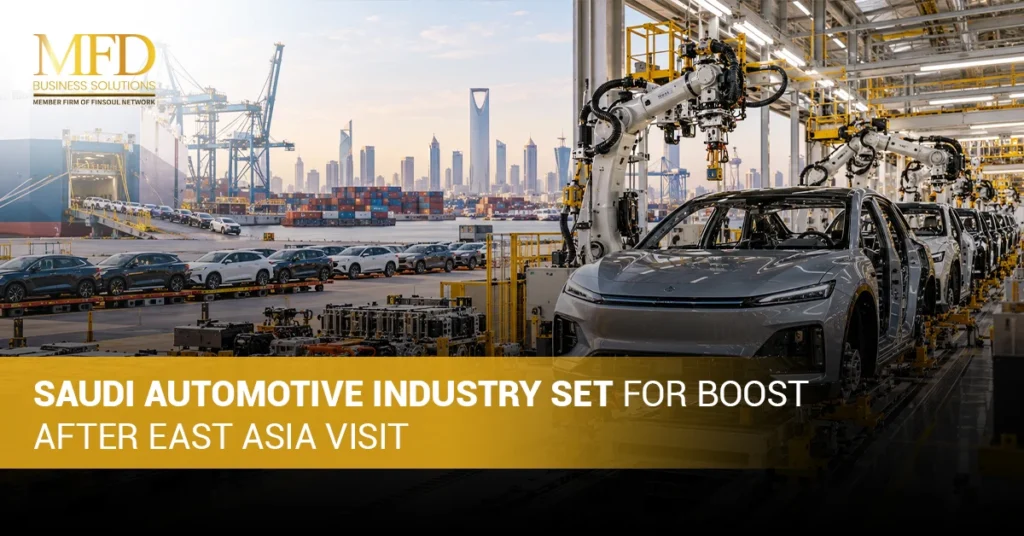
Saudi Arabia is strengthening its position as an emerging automotive manufacturing and investment destination under Saudi Vision 2030. Recent discussions during a high-level delegation visit to East Asia have highlighted opportunities for industrial partnerships, technology transfer, and local supply chain development. These developments could create new opportunities for manufacturers, investors, and service providers across the Kingdom.
The Saudi Automotive Industry is gaining attention as the Kingdom continues to diversify its economy beyond oil and expand its industrial base. For businesses such as MFD Services, understanding these developments can help identify opportunities in manufacturing, investment support, logistics, and industrial consultancy.
A New Phase for Saudi Arabia’s Automotive Sector
Saudi Arabia’s automotive ambitions are closely linked to Vision 2030, the National Industrial Strategy, and the development of a more diversified economy. The Kingdom is working to attract international manufacturers, strengthen local production capabilities, and create skilled employment opportunities for Saudi nationals.
The Saudi Automotive Industry is becoming an important part of these wider economic priorities. Instead of relying primarily on imported vehicles, Saudi Arabia aims to establish a stronger domestic manufacturing ecosystem supported by international partnerships, industrial investment, and local supplier networks.
East Asian manufacturers are relevant to this ambition because countries such as Japan, South Korea, and China have established expertise in vehicle production, automotive components, batteries, and electric mobility. Cooperation with companies from these markets could support the transfer of technical knowledge and manufacturing expertise to the Kingdom.
What the East Asia Visit Could Mean for Local Industry
Engagement with East Asian businesses can open the door to discussions on joint ventures, manufacturing facilities, technical cooperation, and local sourcing. However, the commercial impact will depend on which proposals progress into formal agreements and operational projects.
For Automotive Manufacturing Saudi Arabia, international partnerships could help shorten the learning curve for establishing competitive production facilities. Experienced manufacturers can contribute production systems, quality management practices, engineering expertise, and access to established supplier networks.
Local sourcing is another important consideration. Vehicle manufacturing depends on a broad range of components, including wiring harnesses, tyres, seats, glass, electronic systems, and metal parts. Encouraging suppliers to establish operations within the Kingdom could reduce dependence on imported components over time and strengthen domestic industrial capabilities.
For Saudi businesses, this creates potential opportunities to work with international manufacturers as suppliers, distributors, logistics providers, and specialist service partners.
Developing Manufacturing Hubs Across the Kingdom
Saudi Arabia has several industrial and logistics locations that can support automotive investment. Jeddah offers access to major maritime trade routes and established commercial networks, while the Eastern Province benefits from its industrial base and proximity to important energy and logistics infrastructure. Other industrial locations may also offer opportunities depending on project requirements.
The development of supplier networks near assembly facilities could help create a more integrated manufacturing ecosystem. Rather than importing every component, manufacturers could gradually increase local procurement as suitable suppliers, technical capabilities, and production volumes develop.
This approach could give the Saudi Automotive Industry a broader economic role by encouraging investment in component production, industrial equipment, warehousing, transport, and quality assurance.
Workforce development will also be essential. Automotive facilities require technicians, production supervisors, mechanical and electrical engineers, quality specialists, and supply chain professionals. Training partnerships between manufacturers, educational institutions, and technical training providers can help prepare Saudi talent for these roles.
For employers, building a skilled local workforce can support operational efficiency while contributing to the Kingdom’s wider employment and localisation objectives.
Electric Vehicles and the Next Stage of Growth
Electric mobility is another area of interest for Saudi Arabia. The Kingdom is investing in the wider ecosystem needed to support electric vehicles, including charging infrastructure, advanced manufacturing, and new mobility technologies.
The EV Industry Saudi Arabia opportunity extends beyond vehicle assembly. It can include battery systems, charging equipment, power electronics, software, maintenance services, and recycling solutions. Partnerships with experienced international companies could help develop these capabilities and support the gradual expansion of local expertise.
East Asian manufacturers have substantial experience in electric vehicle production and battery technologies. Cooperation with these companies could help Saudi Arabia develop manufacturing knowledge, improve access to technical expertise, and explore opportunities for locally produced electric vehicles and related components.
The EV Industry Saudi Arabia market could also benefit from the Kingdom’s efforts to expand its domestic industrial base and support more sustainable transport solutions. However, growth will depend on factors such as vehicle affordability, charging availability, consumer demand, and the commercial viability of local production.
As the market develops, the EV Industry Saudi Arabia ecosystem may create opportunities for automotive suppliers, charging infrastructure providers, technology firms, and maintenance businesses.
Key Growth Opportunities at a Glance
| Growth Area | Main Opportunity | Potential Business Impact |
| Vehicle assembly | International manufacturing partnerships | Increased domestic production capacity |
| Automotive components | Local supplier development | More opportunities for Saudi manufacturers |
| Electric mobility | Battery and EV-related technologies | Growth in advanced industrial capabilities |
| Workforce development | Technical training and skills programmes | More skilled employment opportunities |
| Logistics and distribution | Industrial transport and warehousing | Stronger supply chain services |
| Regional exports | Access to GCC and wider regional markets | Potential expansion into new markets |
What Saudi Investors and Businesses Should Know
The expansion of automotive manufacturing could create opportunities across several sectors. Saudi companies and international investors can explore these opportunities by assessing local demand, industrial requirements, regulatory obligations, and potential partnership arrangements.
Early supplier engagement: Businesses that establish relationships with manufacturers during project planning may be better positioned to compete for future contracts.
Industrial and technical services: Companies offering equipment maintenance, engineering, quality assurance, recruitment, and technical training may find opportunities as manufacturing facilities develop.
Logistics and supply chain management: Automotive production requires reliable transport, customs clearance, warehousing, inventory management, and coordination between suppliers. Businesses with relevant expertise can support these operations.
Investment and business advisory: Market research, feasibility studies, company formation support, regulatory guidance, and commercial due diligence can help investors evaluate opportunities in the Kingdom.
Localisation and workforce planning: Companies entering the Saudi market should assess applicable Saudisation requirements, local procurement expectations, workforce availability, and relevant industrial regulations.
For businesses considering Automotive Manufacturing Saudi Arabia, a practical entry strategy should include identifying suitable industrial locations, evaluating potential partners, understanding licensing requirements, and assessing the availability of local suppliers.
MFD Services can position its business support and consultancy offering around these needs by helping companies understand the local operating environment and prepare for market entry.
Saudi Arabia’s Position in the Regional Automotive Market
Saudi Arabia has several advantages that could support its automotive ambitions, including a substantial domestic market, established ports, expanding logistics infrastructure, and a strategic location connecting Asia, Africa, and Europe.
The Kingdom also has the opportunity to serve customers across the Gulf Cooperation Council (GCC) and the wider Middle East and North Africa (MENA) region. However, export growth will depend on competitive production costs, product quality, regulatory compliance, and the ability to meet regional demand.
The long-term strength of the Saudi Automotive Industry will depend on more than attracting vehicle assembly plants. A sustainable sector requires a connected network of manufacturers, component suppliers, technical specialists, logistics providers, and training institutions.
Saudi Arabia’s industrial policies and investment initiatives can support this development, but individual projects will need to demonstrate commercial viability and build capabilities that can compete in regional and international markets.
Challenges Businesses Need to Consider
Although the outlook offers opportunities, automotive manufacturing requires substantial investment, careful planning, and long-term commitment.
- High initial investment: Establishing production facilities and supplier operations requires significant capital, equipment, and technical expertise.
- Local supply chain development: Domestic suppliers may need time and investment to meet manufacturers’ quality, volume, and delivery requirements.
- Skills and training: Specialised technical roles require structured training and continued workforce development.
- International competition: Other manufacturing destinations are also seeking automotive investment and advanced technology partnerships.
- Technology changes: Rapid developments in batteries, software, vehicle electronics, and manufacturing systems require ongoing investment.
- Regulatory compliance: Investors must understand applicable licensing, product standards, environmental requirements, customs procedures, and workforce regulations.
- Project delivery timelines: Announced partnerships do not immediately translate into operational factories. Construction, equipment installation, supplier qualification, and production testing can take considerable time.
Businesses should therefore distinguish between preliminary discussions, signed agreements, announced investments, and facilities that have started commercial production. This approach supports more realistic investment decisions and helps companies identify opportunities at the appropriate stage.
Conclusion
Saudi Arabia’s automotive ambitions reflect its broader drive to diversify the economy, expand industrial capabilities, and attract international investment under Vision 2030. Cooperation with East Asian manufacturers could support technology transfer, local supplier development, and new opportunities across vehicle production and electric mobility.
The long-term outlook for the Saudi Automotive Industry will depend on the successful implementation of investment plans, the development of skilled Saudi talent, and the establishment of commercially competitive local supply chains.
For investors, manufacturers, and service providers, understanding Saudi regulations, industrial locations, localisation priorities, and partnership opportunities will be important when evaluating market entry. Businesses such as MFD Services can support this process by helping companies navigate the Kingdom’s business environment and assess opportunities as the sector develops.
Frequently Asked Questions
Why is Saudi Arabia investing in automotive manufacturing?
Saudi Arabia is seeking to diversify its economy, strengthen domestic industrial capabilities, attract foreign investment, and create skilled employment opportunities in line with Vision 2030.
What opportunities could East Asian partnerships create?
Potential opportunities include vehicle assembly, automotive component production, manufacturing technology, battery systems, technical training, and supply chain development. The actual impact will depend on the agreements that are formally concluded and implemented.
How could electric vehicles support industrial growth in the Kingdom?
Electric mobility could create opportunities in vehicle production, battery systems, charging infrastructure, electronic components, maintenance, and related technologies. Market growth will depend on investment, consumer demand, infrastructure, and production costs.
How can Saudi businesses participate in automotive supply chains?
Businesses can explore opportunities in component manufacturing, transport, warehousing, engineering, equipment maintenance, recruitment, technical training, and industrial support services. They should assess supplier qualification standards and applicable regulatory requirements before entering contracts.
What should international investors consider before entering the Saudi automotive market?
Investors should evaluate market demand, industrial locations, licensing requirements, local workforce needs, supplier availability, operating costs, and potential partners. They should also verify the status of investment announcements and confirm the commercial terms of any proposed project.