
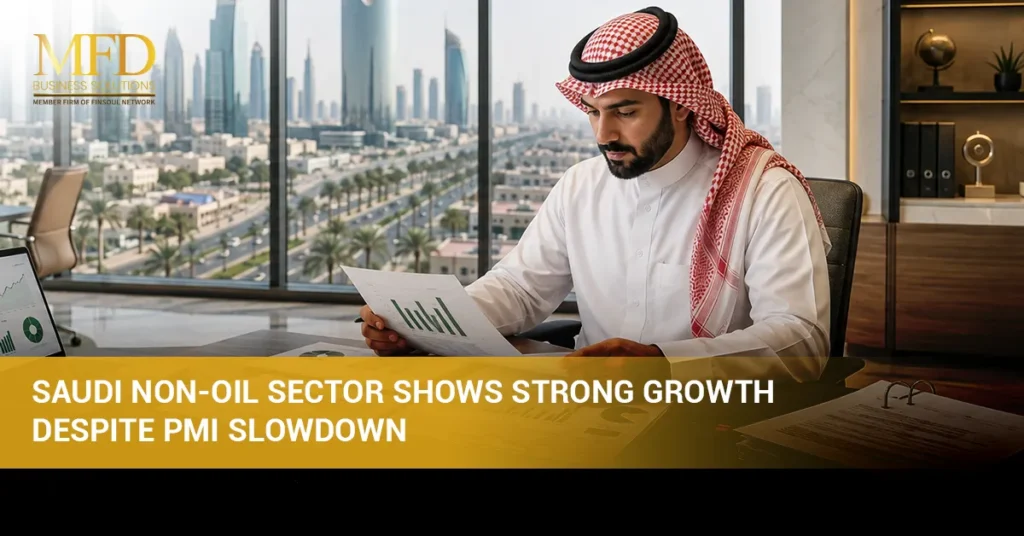
Saudi Arabia’s economy continues to demonstrate resilience as the Kingdom advances its economic diversification agenda under Vision 2030. Although the latest Saudi PMI reading indicates a moderation in private-sector business activity, the broader outlook for Saudi Non-Oil Sector Growth remains supported by infrastructure development, private-sector investment, tourism expansion, and government-led economic reforms.
Across the Kingdom, from Riyadh’s expanding commercial districts to industrial hubs in the Eastern Province and logistics centres in Jeddah, businesses continue to benefit from investments aimed at strengthening the non-oil economy. These developments highlight why a change in the monthly Purchasing Managers’ Index (PMI) should be considered alongside other economic indicators.
At MFD Services, understanding these market developments helps businesses assess opportunities, manage operational challenges, and make informed decisions about establishing or expanding their presence in Saudi Arabia. Examining the factors behind Saudi Non-Oil Sector Growth provides a clearer picture of the Kingdom’s evolving business environment.
Understanding the Saudi PMI Slowdown
The Saudi Purchasing Managers’ Index is an important indicator of private-sector business conditions across the Kingdom. It tracks changes in output, new orders, employment, and purchasing activity through monthly surveys of businesses operating in the non-oil private sector.
A decline in the PMI does not necessarily mean that the economy is contracting. A reading above 50 indicates that business activity is still expanding compared with the previous month, while a reading below 50 signals a contraction in the surveyed sector.
For businesses operating in Saudi Arabia, this distinction is particularly important. The Kingdom’s economic activity is influenced by long-term investment programmes, government spending priorities, domestic consumption, and private-sector participation. Consequently, a softer monthly PMI reading should be assessed alongside actual business performance, new project awards, employment trends, and investment activity.
Rather than interpreting a slowdown as a sign of economic weakness, companies should examine whether demand remains stable across their respective industries and whether their business strategies align with changing market conditions.
Why Saudi Non-Oil Sector Growth Remains Important
Saudi Non-Oil Sector Growth remains central to the Kingdom’s economic transformation. Under Vision 2030, Saudi Arabia is working to diversify national income, strengthen private-sector participation, attract international investment, and develop industries that can contribute to sustainable economic growth.
Several factors continue to support this direction.
Vision 2030 development programmes: Government-led initiatives and strategic development projects are creating opportunities across construction, manufacturing, tourism, transport, and professional services.
Private-sector participation: Reforms designed to improve the business environment are encouraging local enterprises and international companies to explore commercial opportunities in the Kingdom.
Domestic demand: Population growth, urban development, and expanding consumer services continue to support activity across retail, hospitality, healthcare, and other consumer-facing industries.
Foreign investment: Saudi Arabia continues to pursue international partnerships and investment in priority sectors, creating opportunities for businesses with relevant expertise, technology, and operational capabilities.
SME development: Small and medium-sized enterprises play an important role in the Kingdom’s economic diversification strategy, particularly through local supply chains, specialised services, and support for major development projects.
Together, these factors provide a broader basis for assessing economic performance than a single monthly survey. However, individual sectors and businesses may experience different conditions depending on demand, financing costs, competition, and project timelines.
Key Sectors Supporting the Saudi Economy
Saudi Arabia’s economic diversification strategy is creating opportunities across several industries. Their contribution to overall growth varies, but each plays a role in developing a more diverse and competitive economy.
- Construction and real estate: Urban development, residential demand, commercial construction, and major development programmes continue to create opportunities for contractors, engineering firms, building-material suppliers, and property-related service providers.
- Wholesale and retail trade: Consumer demand across Riyadh, Jeddah, Dammam, and other growing urban centres supports retailers, distributors, e-commerce businesses, and local suppliers.
- Tourism and hospitality: Saudi Arabia is investing in cultural destinations, entertainment, hospitality, and tourism infrastructure. Developments in AlUla, the Red Sea destination, Diriyah, and other tourism locations are creating opportunities for hotel operators, travel companies, restaurants, and visitor-service providers.
- Financial services: Banking, fintech, insurance, and business-financing services support commercial activity, investment, and the development of local enterprises across the Kingdom.
- Logistics and transport: Ports, airports, industrial zones, warehousing facilities, and transport networks are strengthening Saudi Arabia’s position as a regional logistics and trade hub.
- Manufacturing and industrial development: Industrial investment, local production initiatives, and supply-chain development are supporting opportunities for manufacturers, equipment suppliers, and businesses seeking to serve Saudi industrial customers.
These sectors operate within different market conditions. For this reason, companies should monitor industry-specific indicators, including customer demand, project awards, procurement activity, and operating costs, rather than relying exclusively on the headline PMI figure.
Vision 2030 and the Development of Saudi Arabia’s Non-Oil Economy
Vision 2030 provides the strategic framework for reducing the Kingdom’s dependence on oil revenues and expanding economic activity across a wider range of industries. Its objectives include developing new investment opportunities, increasing private-sector contribution, supporting Saudi talent, and improving the competitiveness of local businesses.
Several initiatives are particularly relevant to companies considering the Saudi market.
Local content and domestic procurement: The Kingdom’s local content policies and applicable procurement requirements can influence how companies participate in public-sector contracts and major projects. Businesses should assess relevant requirements, including Local Content and Government Procurement Authority (LCGPA) rules where applicable, when preparing bids and developing supplier relationships.
Industrial development: National initiatives supporting manufacturing, industrial localisation, and domestic supply chains are creating opportunities for businesses that can provide locally produced goods, technical expertise, and specialised services.
Foreign investment and market entry: International companies exploring Saudi Arabia should assess the appropriate licensing route, commercial registration requirements, ownership structure, and sector-specific approvals. Requirements depend on the business activity and applicable regulations.
Saudi workforce development: Saudisation requirements, administered through the relevant authorities and programmes, are an important consideration for workforce planning. Employers should review the requirements applicable to their activity, company size, and employee classifications.
SME participation: The development of local enterprises and supplier networks creates opportunities for businesses that can support large contractors, industrial operators, retailers, and service providers.
These initiatives demonstrate that Saudi Non-Oil Sector Growth is linked to a broader programme of economic reform and industrial development. Businesses that understand local regulations, procurement practices, and commercial expectations are better positioned to identify relevant opportunities.
Challenges Facing Businesses in Saudi Arabia
Despite the opportunities associated with economic diversification, businesses operating in the Kingdom must manage several commercial and operational challenges.
- Supply-chain costs: Changes in international freight rates, delivery schedules, and material prices can affect procurement budgets and project timelines.
- Financing conditions: Borrowing costs and access to working capital can influence expansion plans, particularly for SMEs and businesses operating on tight margins.
- Regulatory compliance: Companies must keep up with applicable licensing, tax, employment, Saudisation, and sector-specific requirements.
- Workforce planning: Recruiting qualified employees, meeting relevant Saudisation targets, and managing employment costs require careful planning.
- Market competition: Local and international businesses compete across many sectors, making pricing, service quality, local partnerships, and customer relationships important differentiators.
- Project delivery and payment cycles: Companies supplying major projects should assess contract terms, procurement procedures, payment schedules, and working-capital requirements before committing resources.
For businesses entering or expanding in Saudi Arabia, a practical approach involves maintaining realistic financial forecasts, reviewing regulatory obligations, diversifying suppliers where feasible, and aligning staffing plans with expected demand. Monitoring sector-specific developments alongside the PMI can also help companies make more informed decisions.
Outlook for Saudi Non-Oil Sector Growth
The outlook for Saudi Non-Oil Sector Growth will depend on a combination of domestic demand, private investment, government priorities, international economic conditions, and the progress of major development programmes.
Tourism, logistics, manufacturing, construction, financial services, and technology remain important areas to monitor as the Kingdom continues implementing Vision 2030. Opportunities will vary by sector, location, project stage, and the ability of businesses to meet local commercial and regulatory requirements.
For investors and business owners, the most useful approach is to evaluate a range of indicators over several months or quarters. These may include new business orders, employment levels, project announcements, industrial output, consumer demand, and actual investment commitments.
A single PMI slowdown should not automatically determine a company’s expansion strategy. Instead, businesses should assess the strength of their target market, operating costs, customer pipeline, and long-term commercial objectives.
For international companies, understanding Saudi business practices, relevant licensing procedures, local content requirements, and workforce regulations is particularly important when evaluating market-entry opportunities. For established Saudi businesses, improving operational efficiency and strengthening domestic supplier relationships can help support competitiveness.
Conclusion
Saudi Arabia’s economic transformation continues to create opportunities across a broad range of non-oil industries. Although a moderation in the Saudi PMI may indicate slower growth in private-sector activity, it does not, by itself, establish that the wider economy is weakening.
The longer-term direction of Saudi Non-Oil Sector Growth remains closely connected to Vision 2030, private-sector development, industrial investment, tourism expansion, and the growth of domestic supply chains.
For businesses operating in the Kingdom, the priority is to understand the difference between short-term economic fluctuations and longer-term structural developments. Combining market indicators with sector-specific research, regulatory awareness, and sound financial planning can help companies make better-informed commercial decisions.
MFD Services supports businesses seeking to understand the Saudi business environment, assess market-entry considerations, and navigate relevant operational requirements. With a clear understanding of the Kingdom’s economic priorities and local business landscape, companies can evaluate opportunities with greater confidence.
Frequently Asked Questions
What does the Saudi PMI measure?
The Saudi Purchasing Managers’ Index measures monthly business conditions in the non-oil private sector, including output, new orders, employment, and purchasing activity. A reading above 50 generally indicates expansion, while a reading below 50 indicates contraction compared with the previous month.
Does a lower Saudi PMI mean the economy is contracting?
Not necessarily. A lower PMI can indicate that the pace of expansion has slowed. The index should be assessed alongside other indicators, including business orders, employment, investment activity, and sector-specific performance.
What drives non-oil economic activity in Saudi Arabia?
Vision 2030 initiatives, private-sector investment, domestic consumption, tourism development, manufacturing, logistics, and the expansion of small and medium-sized enterprises all contribute to the Kingdom’s non-oil economy.
How does Vision 2030 support non-oil businesses?
Vision 2030 promotes economic diversification, industrial development, tourism, investment, and greater private-sector participation. These priorities create opportunities for local enterprises and international companies, subject to applicable licensing, procurement, and regulatory requirements.
What should businesses consider before entering the Saudi market?
Businesses should assess their licensing and commercial registration requirements, sector-specific regulations, applicable Saudisation obligations, local content and procurement rules, tax responsibilities, workforce availability, and potential customer demand. Understanding these factors can help companies develop a practical and compliant market-entry strategy.