
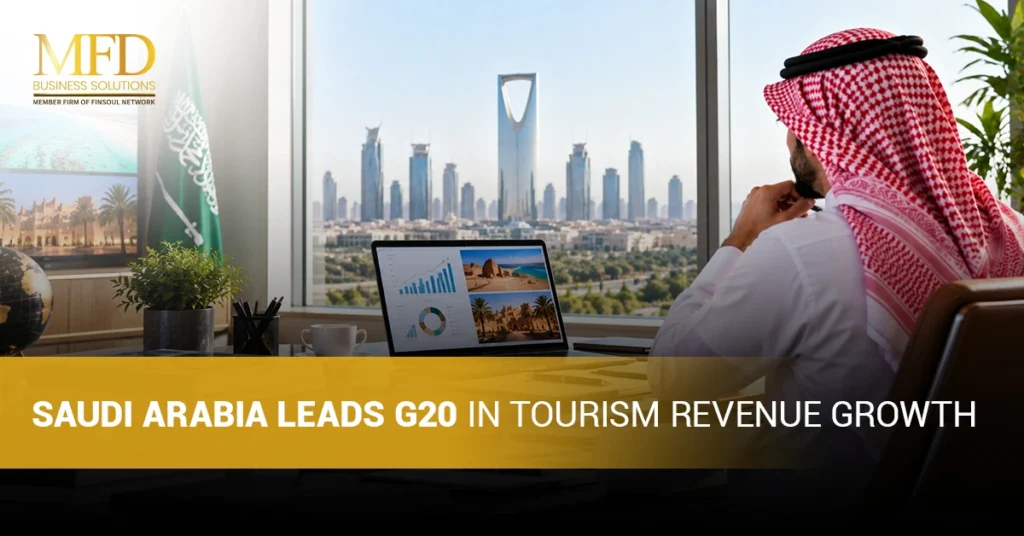
Saudi Arabia has become one of the most talked-about success stories in global travel, and the numbers behind this rise are hard to ignore. According to the UN World Tourism Organization, the Kingdom recorded the fastest Saudi Tourism Revenue Growth among all G20 economies, with international tourism earnings climbing 148 percent compared to 2019 levels.
At MFD Services, we track destination performance data closely, and few markets show a growth curve as sharp and sustained as Saudi Arabia’s. This article breaks down what is driving this Saudi Tourism Revenue Growth, what it means for the region, and why it matters to travelers, investors, and businesses watching the Gulf’s tourism transformation.
What Is Driving Saudi Tourism Revenue Growth
The rise in Saudi Tourism Revenue Growth is not accidental. It is the direct result of Vision 2030, the Kingdom’s long-term economic diversification plan, which placed tourism at the center of its non-oil growth strategy. International tourist arrivals surged to 29.7 million in 2024, up from just 18.04 million in 2016, while domestic travel nearly doubled to 86.2 million over the same period. That combination of inbound and domestic demand has pushed Tourism Revenue Saudi Arabia figures to record highs year after year, and the pattern has held steady across multiple reporting periods rather than appearing as a single strong quarter.
Several structural factors explain this momentum. The e-Visa program now covers dozens of countries, making entry far simpler for international visitors than it was even five years ago. Mega-projects such as the Red Sea Project, Amaala, Diriyah, and Qiddiya have added world-class resorts, cultural districts, and entertainment hubs that did not exist a decade ago. Airport connectivity has also improved substantially, with the Red Sea International Airport opening new routes designed specifically for premium leisure travelers. These developments have transformed the Kingdom from a destination associated mainly with religious pilgrimage into a diversified leisure, business, and cultural travel market, further accelerating Saudi Tourism Revenue Growth across nearly every visitor segment.
Domestic policy has played an equally large role. Entertainment licensing, the growth of live events, and a rapidly expanding calendar of sporting fixtures have given both international and domestic travelers new reasons to visit throughout the year, rather than concentrating demand around a handful of peak travel seasons.
Saudi Arabia and G20 Tourism Rankings
When measured against other G20 economies, Saudi Arabia’s tourism performance stands out sharply. Key points include:
- Leading G20 Tourism Growth: UNWTO barometer reports placed Saudi Arabia first in G20 Tourism revenue growth for consecutive reporting periods.
- Strong Revenue Increase: International tourism revenue recorded a 207 percent increase during parts of 2024 compared with pre-pandemic 2019 levels.
- Outpacing Established Markets: Several major tourism economies in Europe and North America recorded only single-digit or modest double-digit gains over the same comparison period.
- Changing Global Tourism Patterns: Saudi Arabia’s position at the top of the rankings highlights the Kingdom’s growing importance as an international tourism destination.
- Higher Visitor Spending: The Saudi Tourism Revenue Growth trend is also reflected in visitor spending. In the first quarter of 2025, international tourism spending reached approximately $13.2 billion.
- Premium Tourism Offerings: Luxury resorts, major sporting events, and large-scale entertainment programs are helping increase average visitor spending rather than relying only on higher visitor numbers.
Why Tourism Revenue Figures Matter for Saudi Arabia
Strong tourism revenue numbers reflect more than short-term growth. They show a broader shift in Saudi Arabia’s economy and create opportunities across multiple sectors:
Non-Oil Economic Growth: Tourism is becoming an important contributor to non-oil GDP growth and supports the Kingdom’s wider economic diversification strategy.
Job Creation: Growth in tourism is creating employment opportunities across hospitality, transportation, entertainment, retail, and other service industries.
Services Sector Expansion: Rising visitor numbers are supporting the development of hotels, restaurants, travel companies, entertainment venues, and related businesses.
Growing Investment Opportunities: Consistent tourism revenue growth is attracting businesses, investors, and hospitality operators looking for long-term opportunities in the Kingdom.
New Hotels and Resorts: More than 25 new hotels and resorts are expected to open in Saudi Arabia in 2026, adding capacity for the growing number of visitors.
2030 Tourism Target: Saudi Arabia aims to reach 150 million annual visitors by 2030, following the achievement of its earlier 100 million visitor target ahead of schedule.
Long-Term Growth Potential: These developments suggest that Saudi Arabia’s tourism expansion is supported by long-term investment and infrastructure rather than being driven only by short-term events.
The Role of Vision 2030 in Sustaining Growth
None of this progress would be possible without the coordinated push of Vision 2030. Government initiatives, from the “Visit Saudi” platform to the AI-powered tourism assistant known as Sarah, were designed to lower barriers for international travelers and modernize the visitor experience from booking through arrival. The Ministry of Tourism, under Minister Ahmed Al Khateeb, has also positioned the Kingdom to host major global events, from sporting tournaments to cultural festivals, which continue to draw international attention and travel bookings well beyond the Gulf region.
This is where broader G20 Tourism dynamics become especially interesting. While many G20 nations rely on mature, saturated tourism markets, Saudi Arabia is still in an expansion phase, meaning there is more room for continued double-digit growth in the coming years. That structural advantage is a large part of why the Kingdom has consistently outpaced its G20 peers in year-over-year revenue growth rather than posting a single standout quarter followed by a slowdown.
What This Means Going Forward
Sustained Saudi Tourism Revenue Growth suggests the Kingdom’s tourism sector is transitioning from a rapid-growth phase into a maturing, diversified industry. With infrastructure projects improving connectivity and luxury developments like Amaala nearing their first-phase launch, the pipeline for future Tourism Revenue Saudi Arabia growth looks well-supported rather than dependent on one-off events or short-term promotional campaigns.
At MFD Services, we see this as one of the more compelling shifts in global travel data over the past five years. A market moving from under 20 million annual international visitors to a target of 70 million international and 80 million domestic tourists represents one of the more ambitious tourism build-outs currently underway anywhere in the world, and the underlying figures back up that ambition with hard data rather than projections alone.
Conclusion
Saudi Arabia’s rise to the top of G20 tourism rankings is one of the clearest examples of how a coordinated national strategy can reshape a country’s economic profile within a decade. The Saudi Tourism Revenue Growth figures, backed by UNWTO data and reinforced by Vision 2030’s infrastructure push, show a market expanding on both the visitor-count and spending fronts simultaneously. As tourism revenue in the Kingdom continues to climb and new mega-projects open their doors, Saudi Arabia looks set to remain a defining story in global tourism performance for years to come. MFD Services will continue monitoring these trends as the sector moves toward its 2030 targets.
Frequently Asked Questions
What Is Driving Saudi Arabia’s Tourism Revenue Growth?
Vision 2030 reforms, easier e-Visa access, and major projects like the Red Sea Project and Diriyah are the main drivers. These initiatives have expanded both visitor numbers and average spending.
How Does Saudi Arabia Compare to Other G20 Countries in Tourism?
Saudi Arabia recorded the highest tourism revenue growth rate among all G20 nations in recent UNWTO reports. Its growth has significantly outpaced more established G20 tourism markets.
How Much Did International Tourism Revenue Grow in Saudi Arabia?
International tourism revenue rose 148 percent in 2024 compared to 2019, with some quarterly reports showing growth as high as 207 percent. This places the Kingdom well ahead of typical global tourism recovery rates.
What Is Saudi Arabia’s Tourism Target for 2030?
The Kingdom aims for 150 million annual visitors by 2030, split between 70 million international and 80 million domestic tourists. This target was raised after the original 100 million goal was met seven years early.
Why Is Saudi Arabia’s Tourism Growth Important for Its Economy?
Tourism has become a key driver of non-oil GDP growth, job creation, and services-sector expansion. It is also supporting the Kingdom’s broader economic diversification goals under Vision 2030.
The IMF has highlighted it as central to the Kingdom’s broader economic diversification strategy.