
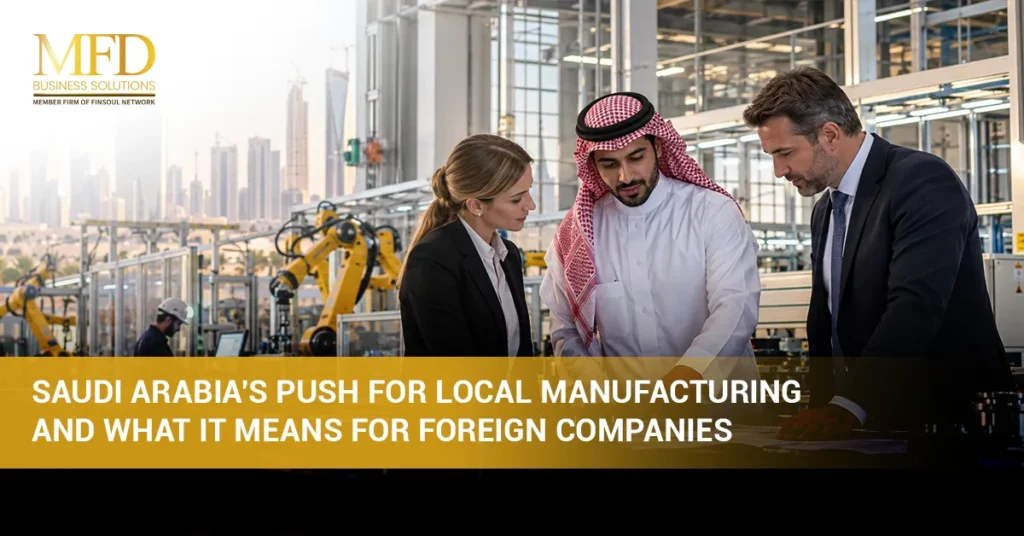
Saudi Arabia is putting more focus on producing goods inside the Kingdom. The aim is to build local factories, support Saudi suppliers, create jobs, and reduce dependence on imported products. This change is also creating new possibilities for international businesses that want to establish a long-term presence in the country. For many investors, manufacturing investment in Saudi Arabia can be a way to serve local customers while becoming part of growing industrial supply chains. The change is not limited to large factories. It also includes assembly, component production, packaging, maintenance, technical services, and local sourcing. Government programs are supporting this direction through industrial development, local-content policies, financing, and investment support. Foreign companies now have more reasons to study local production and decide which entry model fits their products, customers, costs, and long-term plans.
MFD Services can help international businesses understand the practical requirements of setting up and operating in Saudi Arabia. Its support can cover business setup, investment-related requirements, and other matters that companies need to review before starting local operations.
What Is Driving Saudi Arabia’s Push for Local Manufacturing?
Saudi Arabia wants to build a stronger economy that does not depend mainly on oil revenues. Local manufacturing can help the Kingdom produce more goods at home, create employment, develop technical skills, and support Saudi suppliers. It can also reduce the need to import products that can be made locally.
Vision 2030 is supporting this wider economic change. The National Industrial Development and Logistics Program is also focused on developing industries, supply chains, logistics, and investment. Government procurement policies can give greater importance to local content in applicable contracts.
The goal is not simply to build more factories. Saudi Arabia also wants companies to develop local skills, buy from Saudi suppliers, transfer knowledge, and create lasting industrial capacity. This creates opportunities for international businesses with products, technology, and experience that match the Kingdom’s industrial needs.
What Does Local Manufacturing Mean in Saudi Arabia?
Local manufacturing means making a product, part, or component inside Saudi Arabia instead of importing the complete item from another country. The level of local production can differ between businesses. One company may assemble imported parts in Saudi Arabia, while another may manufacture most components locally and purchase materials from Saudi suppliers.
Local content is related to this process but has a wider meaning. It can include spending on local goods and services, employee-related costs, training, assets, and other qualifying activities. The exact calculation depends on the applicable program, contract, or sector.
This means foreign businesses should not assume that localization always requires a complete factory. A company may start with assembly or selected local sourcing and increase its local production later. The right model depends on its products, customers, costs, and applicable requirements.
How Saudi Arabia Is Building Industrial Localization in the Supply Chain
Saudi Arabia is working to bring more parts of industrial supply chains into the Kingdom. This includes local sourcing, supplier development, production, workforce training, and knowledge transfer. These efforts can help local businesses become suppliers to larger manufacturers and major industrial buyers. The Saudi manufacturing sector is gaining attention as more industries develop local production capacity. Programs linked to local content can also encourage businesses to purchase more goods and services from Saudi suppliers.
Large companies are contributing to this change through their own supplier programs. Aramco’s IKTVA program is one example. It encourages suppliers to increase their local contribution and develop manufacturing capabilities inside the Kingdom. For foreign businesses, this creates a possible path into the market. A company may begin by exporting products, then move to local assembly, source selected materials locally, or establish full production when demand and business conditions support the move.
What Does This Mean for Foreign Companies?
Saudi Arabia’s manufacturing push can change how international companies approach the market. A foreign business that only exports finished goods may have fewer local connections than a company that produces, assembles, or sources part of its products inside the Kingdom. Local production can bring a company closer to customers and suppliers. It may also reduce delivery times for some products and make after-sales support easier. Companies can develop Saudi employees and build relationships with local suppliers at the same time.
This does not mean every international business needs to build a factory. Exporting may still be suitable for some products. Other companies may benefit from a local partner, contract manufacturing, or a smaller assembly operation. The main question is whether local production makes commercial sense. Companies need to compare demand, factory costs, workforce costs, logistics, supplier availability, and customer requirements before making a decision.
Which Manufacturing Sectors Offer Opportunity for Foreign Companies?
Saudi Arabia is developing local capacity across several industries. This creates opportunities for foreign businesses that have suitable products, technology, production skills, or specialist services. Potential areas include:
- Energy and industrial equipment
- Chemicals and specialty materials
- Mining equipment
- Automotive components
- Food processing
- Food and industrial packaging
- Pharmaceuticals
- Medical products
- Renewable-energy equipment
- Machinery
- Construction materials
- Advanced industrial products
The strongest opportunity will not be the same for every company. Businesses should study local demand, existing manufacturers, major buyers, import volumes, supplier gaps, and future projects. A foreign manufacturer may have a stronger case for local production when its product has regular demand and limited domestic supply. A product that already has many established local producers may require a different market strategy.
Can Foreign Manufacturing Affect Market Entry?
Yes, local manufacturing can affect the way a company enters Saudi Arabia. Businesses that produce inside the Kingdom may have stronger links with local buyers, suppliers, employees, and industrial projects. Foreign manufacturers Saudi Arabia can also benefit from being closer to their customers. Local production may help reduce delivery times and provide better control over stock for products with regular demand.
Local manufacturing can also matter when a company wants to work with buyers that have local-content expectations. The effect will depend on the specific contract and applicable rules, so businesses should check the requirements before assuming that a factory will improve procurement opportunities. Manufacturing also brings additional responsibilities. A company may need industrial approvals, factory space, equipment, employees, utilities, product compliance, supplier checks, and ongoing operational controls. For this reason, local manufacturing should be viewed as a business decision, not simply a response to government policy.
What Changes Should Foreign Companies Expect?
Foreign businesses should expect greater attention to local suppliers, Saudi employment, domestic production, and local-content requirements. Companies may need to review their existing supply chains and identify products or materials that can be sourced locally. This can change supplier contracts, purchasing costs, delivery arrangements, quality checks, and production schedules.
Businesses may also need to invest in employee training and develop relationships with Saudi suppliers. These changes can take time, especially when a product requires specialist materials or technical standards. The regulatory side also needs attention. Companies should check investment rules, industrial licensing, product standards, tax, customs, employment requirements, and sector-specific approvals before starting operations.
The regulatory side also needs attention. Companies should check investment rules, industrial licensing, product standards, tax, customs, employment requirements, and sector-specific approvals before starting operations. Taxation Advisory (ZATCA) Services in Saudi Arabia can help foreign businesses review applicable tax obligations, including VAT, Zakat, corporate tax, and other requirements that may affect their manufacturing operations. The effect will differ between industries. A company making industrial machinery may face different requirements from a pharmaceutical, food, automotive, or energy-equipment business. A project-specific review is therefore needed before deciding on the production model.
Should a Foreign Company Manufacture in Saudi Arabia?
A foreign company should manufacture locally when the numbers and market conditions support the move. Manufacturing investment in Saudi Arabia may make sense when a business has strong local demand, regular orders, high shipping costs, customer preference for local supply, or applicable local-content requirements.
Exporting can remain a good option when demand is still uncertain or production volumes are too low to justify a factory. A company can test the market through exports before moving selected production activities to Saudi Arabia. Another option is local assembly. This can give a business a local presence without requiring the same production scale as a full manufacturing facility.
The decision should be based on the complete cost of doing business. Companies should compare freight, customs, warehousing, equipment, factory costs, employees, utilities, local sourcing, financing, compliance, and expected sales.
How Can Foreign Companies Enter Saudi Arabia?
Foreign companies can follow a clear process.
Step 1: Study the Saudi Market
Research customer demand, competitors, pricing, import volumes, and expected sales before selecting a product or location.
Step 2: Review the Product
Identify which parts can be manufactured, assembled, packaged, or sourced locally.
Step 3: Check Legal Requirements
Review investment, industrial licensing, product approvals, workforce rules, tax, customs, and procurement requirements that apply to the activity.
Step 4: Select an Entry Model
Compare exporting, local assembly, contract manufacturing, a Saudi partnership, and a fully owned manufacturing operation.
Step 5: Review Costs and Support
Calculate factory, equipment, staffing, logistics, raw materials, utilities, and financing costs. Check relevant government support programs.
Step 6: Prepare the Saudi Operation
Choose a suitable location, identify suppliers, plan staffing, arrange registrations and approvals, and set realistic production targets.
A company should complete these checks before committing significant capital. Regulatory Matters Services can help foreign businesses review licensing, documentation, regulatory requirements, and other approvals connected with their planned Saudi operation. This gives investors a clearer picture of the market, costs, requirements, and possible returns before they move forward with their manufacturing plans.
What Should Foreign Companies Do Before Investing?
Foreign businesses should review six areas before committing funds.
- Market demand: Check customer needs, sales potential, competitors, and future demand.
- Production model: Decide whether exporting, assembly, contract production, or a factory is suitable.
- Legal requirements: Review investment, industrial, licensing, workforce, tax, customs, and product rules.
- Local suppliers: Check supplier quality, capacity, prices, delivery times, and production standards.
- Financial planning: Compare equipment, factory, staffing, logistics, financing, and operating costs.
- Long-term goals: Set production targets and decide how the Saudi operation could support future growth.
Industrial investment Saudi Arabia can be attractive for companies that have a clear market opportunity and a realistic plan for local production. Investors should also review available industrial financing and support programs before selecting a final structure.
Why Choose MFD Services for Manufacturing Business Support in Saudi Arabia?
Setting up or expanding a manufacturing business in Saudi Arabia requires attention to investment rules, licensing, tax obligations, documentation, and sector-specific requirements. Our team helps foreign companies understand these areas before they commit to major investments. We can support businesses with tax advisory, regulatory matters, company setup, and other business requirements linked to their Saudi operations. This practical support helps manufacturers plan their activities with a clearer view of the requirements involved. Our approach is based on the company’s industry, investment plans, and operational needs, helping foreign businesses prepare for the Saudi manufacturing market.
Conclusion
Saudi Arabia’s move toward local manufacturing is changing the way foreign companies can approach the Kingdom. The opportunity is not limited to large factories. Businesses can enter through local assembly, supplier partnerships, component production, contract manufacturing, or full-scale production. The right option depends on demand, costs, customer needs, regulations, and local-content requirements. Manufacturing investment in Saudi Arabia can support long-term market growth when the project has a strong commercial case.
MFD Services can help foreign businesses review company setup, investment requirements, compliance, and other requirements before establishing operations. Companies should study their target industry, suppliers, workforce needs, licensing requirements, and expected returns before investing. This can help businesses choose the right production model and build a practical plan for operating in Saudi Arabia.
FAQs
Does every foreign company need to manufacture in Saudi Arabia?
No. Some businesses can continue exporting, while others may benefit from local assembly, sourcing, or production. The right approach depends on the business activity, customer requirements, contracts, and applicable local-content rules.
Can foreign companies own manufacturing businesses in Saudi Arabia?
Foreign ownership may be available for eligible manufacturing activities, subject to applicable investment and licensing requirements. Companies should check the rules for their specific activity before establishing a local operation.
What is local content in Saudi Arabia?
Local content generally relates to the value created or spent inside Saudi Arabia through qualifying goods, services, employees, assets, and related activities. The calculation can differ by program, contract, and sector.
What opportunities are available for foreign manufacturers?
Opportunities can exist in areas such as energy equipment, chemicals, mining, automotive components, food processing, pharmaceuticals, machinery, and renewable-energy products. The best option depends on local demand and supply gaps.
Is manufacturing better than exporting to Saudi Arabia?
Not always. Manufacturing can make sense when demand is strong and local production improves costs, customer access, or procurement opportunities. Exporting may be better when sales volumes are uncertain or factory costs are too high.